The Art of Possibility
Creative entryways into Dorothy Day’s legacy are explored in the “Saved by Beauty” column. Writer and arts administrator, Mary Beth Becker, spoke with sculptor Brian Hanlon about his commission to create a statue of Dorothy Day.
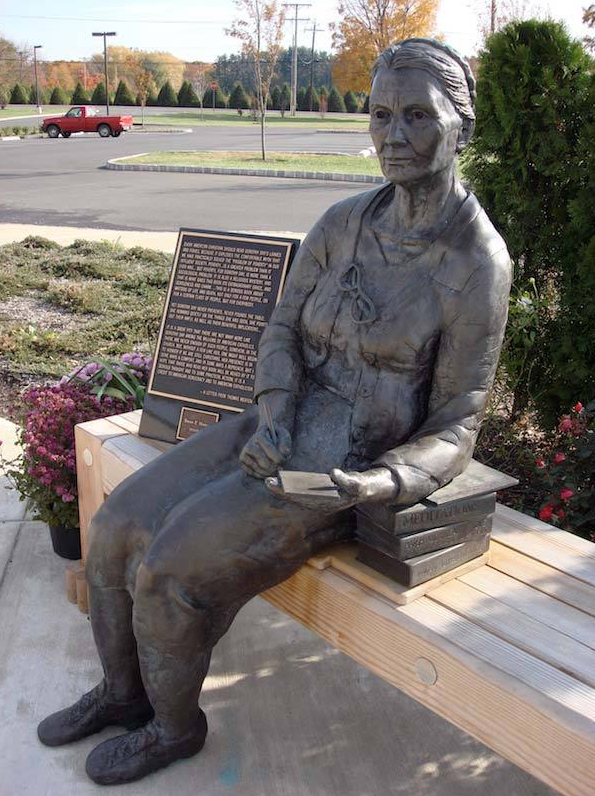
There is a life-size bronze statue of Dorothy Day in central Monmouth County, New Jersey. The statue, commissioned by a priest who paid for it himself, was a gift to his parish at St. Mary's Church in Colt's Neck upon his retirement in 1996. The priest, Father William Bausch, wanted to continue to inspire his parishioners as they exited the church every Sunday morning. What better way to reinforce the final words of the Mass — “Go in peace,” and our response, “Thanks be to God” — than to contemplate Dorothy Day.
She is seated on a bench outside the church, appearing not heroic but human. She could be waiting for a bus. You can almost feel her weary body, her arm resting on a pile of books, her hand gripping a pencil and notepad, her shapeless dress, the casual way she loops her eyeglasses in the buttonhole of her cardigan, the familiar braid of hair that encircled her head.
Her eyes are alert and straightforward as if she might be waiting for us to join her on the journey. “He wanted the statue to be staring at the front door — they have to look in the eyes of Dorothy Day,” said Brian Hanlon, the artist, speaking of the directives he received from Father Bausch. “That commission was the most unique in my entire career of 700 statues across America.”
Father Bausch had been Brian's pastor at St. Benedict's Church in Holmdel, New Jersey, when he was growing up. A recognized author of books on parish ministry, a distinguished homilist, and a storyteller, Father Bausch was first and foremost a pastoral priest with a commitment to the laity. “He was a great source of good counsel for my mother who wound up raising six kids basically by herself.” Years later, Father Bausch would reach out to Brian about his plans to commission a statue. “I honestly didn't know who she was. I heard of the Catholic Worker, but I didn't know who Peter was, I didn't know who Dorothy was.”
It seemed in speaking with Brian that he knew a lot about Dorothy Day, not simply facts but essential truths, the kind of things you get when you take the time to really see someone.
A former Catholic Worker and Day biographer, Jim Forest, wrote in a personal remembrance of Dorothy that he was struck by her ability to focus on the person she was talking to, not to see a young face but your face, not discerning just a vague, general promise, but your particular gifts. Through Dorothy, you glimpsed exciting possibilities in yourself that you hadn't seen before.
“Through Dorothy, you glimpsed exciting possibilities in yourself that you hadn't seen before.”
Art is all about possibility. Dorothy understood that well. In her voluminous writing, she evoked possibility. And in the life she created at the Catholic Worker — practicing the art of personalism, the art of hospitality, the art of peacemaking — she showed that even the Gospel was possible.
The artist is a devoted servant, working tirelessly to give life to something not yet formed, and for the effort surprised by grace with a vision that exceeds their own expectations.
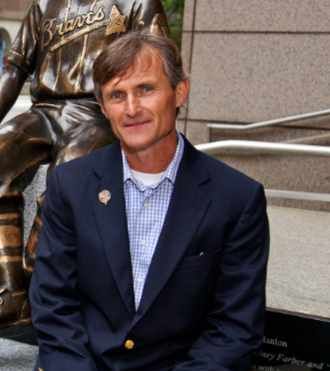
When the statue of Dorothy Day was completed, Hanlon decided to include a bronze plaque. The inscription was drawn from Thomas Merton's preface to Dorothy's second memoir,
Loaves and Fishes:
It is a great pity that there are not many more like Dorothy Day
among the millions of American Catholics. There are still Christians.
Her presence is in some ways a comfort, and in some ways a reproach.
But I hope that those who read her book will be moved by it to serious
thought and to some practical action: it is a credit to American
Democracy and to American Catholicism.
Statues and monuments reflect how we see ourselves, our aspirations, our values and what we as a society hold dear. In recent years, we have experienced as a nation an upheaval in our representation of history, culture and essential truths. But art will never be contained. It is resilient and emerges in unlikely places like the ailanthus trees that Dorothy wrote about in her journals. It has the capacity to illustrate the full human experience, to give voice to the marginalized and a face to the forgotten. Artists like Ade Bethune and the engraver Fritz Eichenberg revealed this in the pages of the Catholic Worker newspaper. Dorothy Day recognized art as one of the spiritual “weapons” along with direct action and the power of non-violence to move people, to arouse acts of conscience, and to change the social order.
“Statues and monuments reflect how we see ourselves, our aspirations, our values and what we as a society hold dear.”
A youthful field trip to the Museum of Modern Art to see Picasso's Guernica was the catalyst that ignited Brian Hanson's will to become an artist. When I asked if anyone else in his family had expressed a similar passion, he laughed. “It's not a casual endeavor... they saw everything I did and they still do ...but I would never push something like this, which is a passion, on one of my children.”
He then described in some detail the process of making a sculpture. “I don't need to do a small study model because my brain works differently now, and I go right to the big one. First, I make an armature in steel, chicken wire and little pieces of wood, and whatever else is on the floor, and that holds the clay on the armature. It's rendered in clay, modeled in clay, and then a mold is made from that, and the mold is made of first rubber and then fiberglass. And then that mold is used to make a wax casting of what the clay used to look like, and that wax is used to make a ceramic shell investment that you pour the metal in. It's very complicated. Very dangerous.”
Then returning to my original question he added, “They all chose their own path. They're all very different and that's great...And they all know who Dorothy Day is, all five kids.”
Currently, Brian is working on a statue of St. Ignatius Loyola, a commission for Pedro Arrupe Jesuit High School in Denver, Colorado. Part of the Cristo Rey network of schools rooted in the Jesuit tradition, the school is dedicated to serving low-income students and fostering an exceptional educational experience through rigorous academics, formation in faith and discernment, and a unique work study program.
Brian spoke of his work-in-progress with passion. “Ignatius has a great story going — from soldier to missionary. He and Peter Faber and Francis Xavier — they were all roommates at the University of Paris … that's what I'm trying to depict … he founded this idea in his dorm room! It can happen. It can happen. I like that.”
The amazing spiritual friendships that led to the founding of the Society of Jesus are not unlike the stories of the Catholic Worker community:
We were just sitting there talking and people moved in
on us ...we have learned that the only solution is love and
that love comes with community. It all happened while
we sat there talking, and it is still going on.
Thirty years have passed since Father Bill Bausch was inspired to commission a statue of a laywoman to gift his congregation. Today, Dorothy Day’s gaze remains fixed on the front door of the Parish of St. Mary. It is still going on.
Share this post