Our Beloved Community
In “Sowing Seeds,” we look at Catholic Worker communities today, some older, some new, all sharing life in common. Chris and Jackie Doucot have been growing community at the Hartford Catholic Worker since its very beginning over thirty years ago.
It’s morning on Palm Sunday. Raucous music is pulsing through the walls of the Haitian evangelical church across the street. The church was formerly St. Michael’s Catholic Church. Jackie and I were married there by Fr. Al Jaenicke and Daniel Berrigan, S.J. in 1991. By 1993, we drew a circle around the church on a map and began looking for abandoned buildings that might become St. Martin De Porres House. There were plenty, there still are plenty. The story of how we were able to buy the house, and later a second, directly across the street from our parish is surely one of Dorothy’s miracles.
Jackie left early this morning to begin a peace walk from the Green in New Haven to the Sub Base in Groton where others from our community will join the pilgrims to pray the Stations of the Cross for peace. Meanwhile, we have a steady stream of suburban churches dropping off bushels of food today. Jackie and I are an anti-nuclear family. Sure, we oppose nuclear weapons, but we also question the wisdom of the nuclear family. I’m not sure the isolation that passes for privacy for the suburban nuclear family is the healthiest way for us to be, and to be present for one another. When we began the Hartford Catholic Worker with Brian Kavanagh our son Micah was an infant. About a year later his brother Ammon was born. They have always referred to Brian as Uncle Brian because he is de facto family. We came to this entirely nonwhite and severely impoverished neighborhood to perform the Works of Mercy on a daily basis in a personal manner. We assumed we would share our home and our food, but the particulars of how we did so were left to the emerging, ongoing conversation we’ve been having with our neighbors since we’ve arrived.
This process is how we ended up working with kids. They saw our dog and introduced themselves. They saw we always had fruit and so they came to the door asking for apples and oranges. They saw we rode bikes and so they came asking for help fixing a flat. They saw we had playground equipment for our sons and so they asked if they could play. And thus, our family grew as these kids became cousins to our kids.
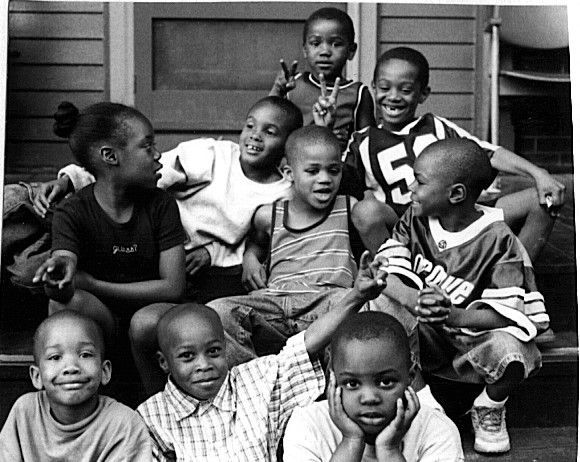
Sometimes kids moved in. Marisol was in high school and abandoned by her family. She stayed for years. I walked her down the aisle on her wedding day and her kids call me and Jackie “padrino” and “madrina.” Morliana was also in high school, and an immigrant without papers when she moved in. Mo met us as a stranger, became a guest, later joined us as a community member, and by the time she left years later she, like Marisol, had become our daughter. We “adopted” each other. It was Thanksgiving when Mo, seven months pregnant, came by to visit and say thank-you to us. She didn’t look well and she ended up in the hospital. Her baby was delivered early and while she stayed, impatient lil’ Lilly came home with Jackie and me. She and her sister Rose are our granddaughters. My heart melts when they call me Pop.
While I click away on the keyboard, Marisol is downstairs with Pito, Lito, Catherine, Ammon, Vianai, Rafaelo, Sasean, and Fey making up the food boxes that we will soon deliver. Pito is nearly thirty now. He started coming by when he was four. He lived with us for a while when he was in grade school until DCF came to take him and a younger brother. We tried to become foster parents… but can ya blame the state for giving us the side eye, given our long arrest records and the constantly changing cast of characters dwelling under these roofs? Pito has been a part of our life in community for a year now — I couldn’t be prouder.
A little while ago Eric stopped by on his bike. Eric is a Black fellow in his fifties. He has a disability, but SSI is not enough to pay his rent so he’s always looking for odd jobs and a bag of food. Just as he was dismounting his bike, a carload of white suburban church folk pulled up with more Easter food. Eric jumped right in with good cheer to help unload while the driver was looking around for who was in charge. The Holy Spirit can be hard to see even when she's right in front of us.
“The Holy Spirit can be hard to see even when she’s right in front of us!”
Catherine just arrived. She’s in her thirties and grew up as one of our Green House kids. No one calls our places St Martin’s or St. Brigid’s or the Catholic Worker — to the ‘hood we are the Green House and the Purple House. Catherine bounded up to my third-floor office to give me a hug and to ask me if I got the leftovers she left for me; yesterday Catherine cooked for our Saturday program. A couple of dozen neighborhood kids and a couple of dozen suburban folks gather every Saturday to play, make art, share a meal, and build the Beloved Community by pursuing “right relationships.” One of my favorite photos is of Catherine and my son Micah on the night of Catherine’s quincinera. Catherine is wearing a gorgeous, elegant royal blue dress; both she and Micah are beaming.
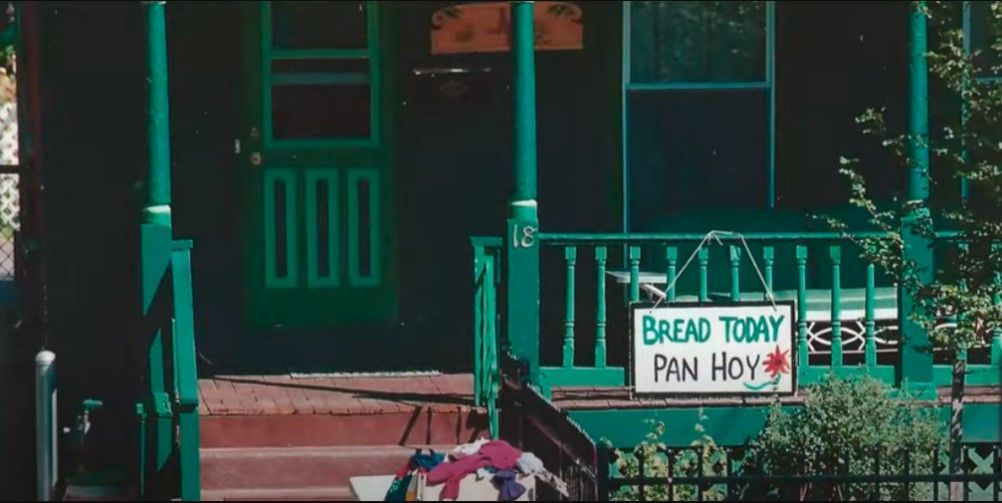
All of these folks have survived incredible trauma. Amongst them are survivors of childhood sexual assault (one of these folks became a father against his will at thirteen!), many of them have had friends and/or family members killed or have close family incarcerated. They have been homeless and in foster care, they have been deeply impoverished (they are not poor — which implies they somehow failed, they have been impoverished, which is a failure of our society), they have had an infant nephew killed in a drive-by, they have had an infant die of SIDS, they have had friends who have killed other friends, they have a brother who will soon likely be sent to the federal death row. One of them got a call earlier this week from the prison where his father is incarcerated to inform him that his father died and as next of kin he needs to claim the body. This kid is just nineteen, he buried a close friend two weeks ago…
And still their laughter is rising through the stairwell into my office. They all carry a heavy cross, but because they carry it together, they don’t stay down when they fall. I too am a survivor of childhood sexual assault. If we’re honest, we all have brokenness and so we all need each other. Rugged individualism is a pernicious lie. Our species is utterly interdependent — without care from others none of us survives our first week, or any other week. Perhaps my survival has led me to this life. Most definitely, my survival has depended on the help of this Beloved Community.
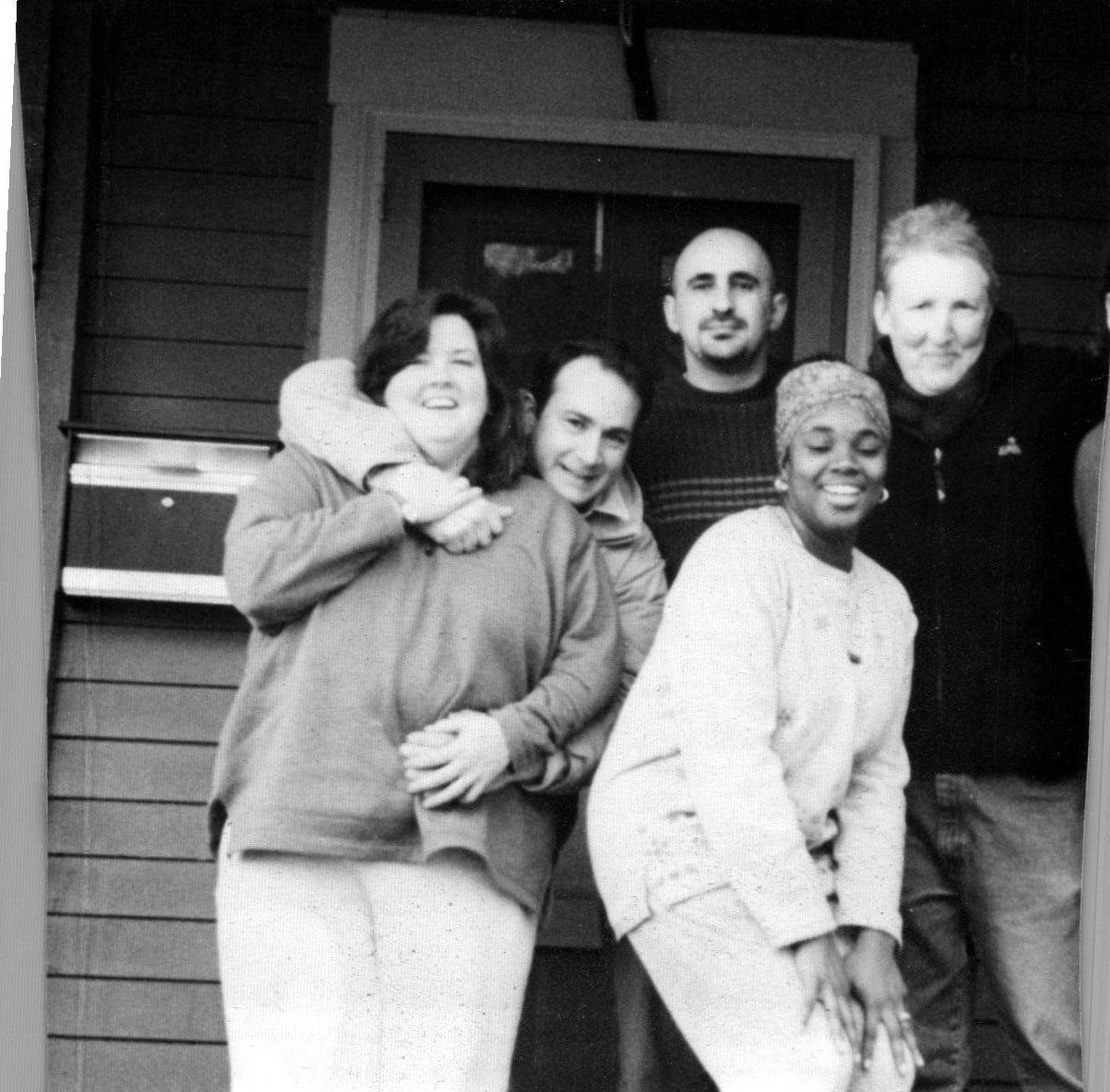
Many years ago, Jackie began the ritual of Circle. When we end the program with the kids, and before we eat Saturday lunch, everyone gathers to hold hands in a circle. We all introduce ourselves and share one thing we are thankful for. On Saturdays the circle can have seventy-five people in it. Urban, suburban, and rural folks, folks ages five to eighty-five, white folks, Black folks, and brown folks, straight, gay, and bi folks, folks who exist all along the neurological spectrum, veterans and children survivors of war in Iraq and Palestine. At every circle, everyone has always expressed gratitude for something in this life. We all have reasons to give thanks.
We all also have gifts to offer. Right now, Lito is tenderly caring for Brian who is recovering from a broken hip; the tables have not been turned with Lito becoming the caregiver, rather a table that once had one seat now has two, as Brian and Lito are metaphorically passing the mashed potatoes to each other. This is what it looks like to come to the table of the Lord together. The litanies of traumas our Beloved Community endures are not what defines us. Our relationships do.
“The litanies of traumas our Beloved Community endures are not what defines us. Our relationships do.”
In the context of those relationships, we give each other gifts all the time. We urge suburban folks who come here to stay home if they are seeking to save, rescue, fix, or heal someone other than themselves. We encourage them to come here and “walk humbly” alongside our neighbors, to give and receive gifts, to console and seek consolation. One-way paternalistic relationships undermine dignity and reinforce disempowerment. Mutuality, respect, and reciprocity are the foundation of the “right relationships” from which shalom emerges.
The kids in the gangs say of their commitment to one another that they are “down 24-7-365,” that is they have each other’s backs all the time. Solidarity. Solidarity is the re-membering of the Mystical Body of Christ; it is the consecration of our lives as we become eucharist for one another. When we come together to share the burdens of our Crosses we rise above the poverty and other forms of violence that the mighty use to try to keep us down. This is Resurrection! And this is what keeps us going.
Share this post