Works of Mercy and Works of Peace: A Late-Summer Missive from the Guild
Dear Dorothy Day Guild members and friends,
Greetings and peace to each of you, your families, and your communities. As always, we hope this missive finds you well. This month’s update is a quick one, but we have a few invitations for fall events to share with you, as well as some reading and listening recommendations (including a collection of audio recordings of Dorothy’s talks and lectures you may not have heard before!) for the end of the season. Thank you so much for your enthusiastic support for our cause; keep reading to learn more about how you can continue to be involved in the coming months!
Upcoming Events from the Dorothy Day Guild:
First, we are very excited to announce that our first autumn walking pilgrimage in Manhattan is scheduled for Sunday afternoon on September 27th. These guided walks are such a wonderful way to prayerfully inhabit the spaces and neighborhoods that shaped Dorothy’s early adulthood and her later witness through the Catholic Worker movement, and we hope you’ll be able to join us this fall if you haven’t been part of one of our pilgrimages yet!
For those who can’t make it to New York, this recent video from The Good Newsroom based on our walking pilgrimage offers a chronological overview of important sites related to Dorothy and the Catholic Worker across Manhattan, Brooklyn, and Staten Island from Dorothy’s birth in 1897 to the present day.
We would also like to invite you to be part of our back-to-school book club, starting September 30th! In the weeks leading up to Dorothy's birthday in November, we are delighted to welcome you to a six-session, online reading group of All The Way to Heaven: The Selected Letters of Dorothy Day, led by Robert Ellsberg, the editor of this collection.
Our Fall 2026 book club will meet on Wednesday evenings from September 30th through November 4th from 8:00-9:15 PM Eastern each week. Each week, we'll read one section and discuss it together over Zoom.
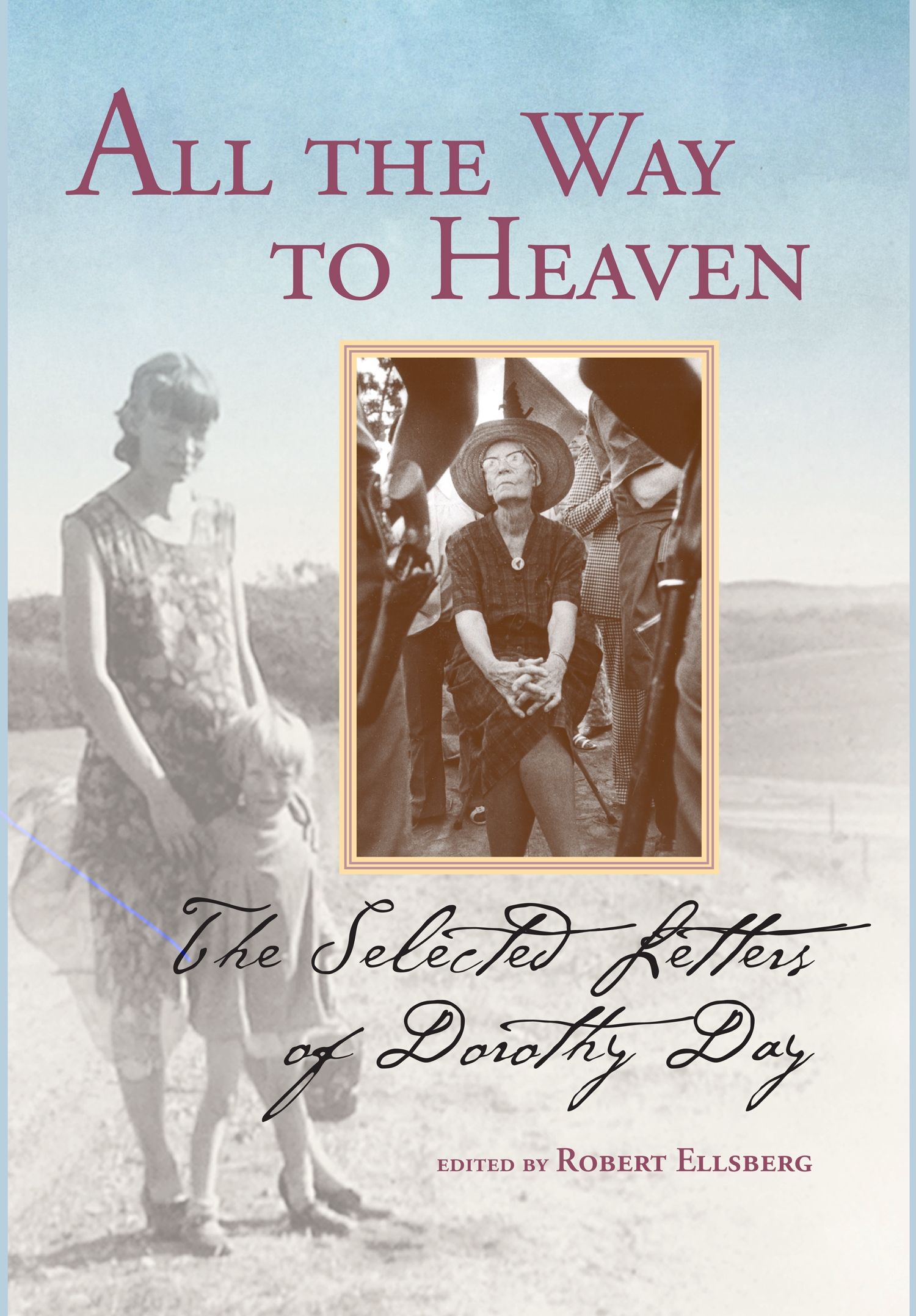
Our online reading groups have been among the Guild’s most popular programs over the past three years, and we’ve now shared Dorothy’s memoirs, columns, and other texts with more than two hundred people. This year, as we await the hopefully forthcoming decision of the Vatican to declare Dorothy “Venerable,” the next step in her canonization, we have a special offer: the Dorothy Day Guild is offering free, hardcover copies of All The Way to Heaven to our members, and as a special thank-you for your ongoing support, Robert has graciously agreed to sign copies of the collection for book club participants!
Robert also spoke with The Good Newsroom recently and described his experience editing Dorothy’s personal writings, including both her diaries and her letters, and how coming to know her in this intimate way after her death helped him to understand her spirituality. You can watch this short interview here.
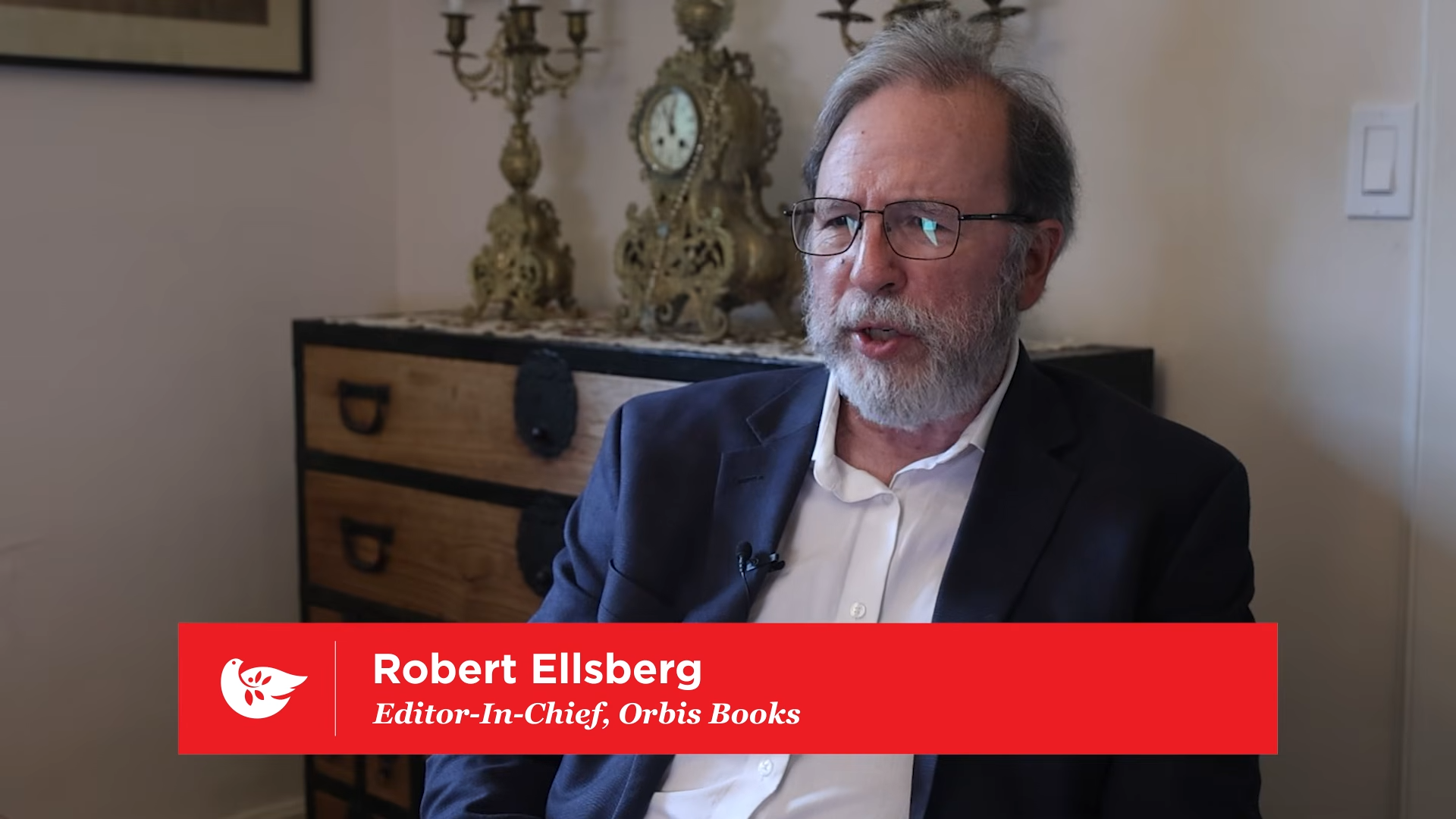
To join our book club and request your autographed copy of Dorothy’s selected letters, please fill out our registration form, and keep an eye on our events page for more forthcoming invitations between now and Dorothy’s anniversaries of birth and death in November.
Other Events for Your Calendar:
We’d also like to pass along a few upcoming events being hosted by friends of the Guild this season. First, for those in the Washington, DC area, members of the Dorothea Project, in collaboration with the Archdiocese of Washington, will be celebrating a special Mass for the Feast of Our Lady of Sorrows on Tuesday, September 15th, from 10:00 AM-12:00 PM.
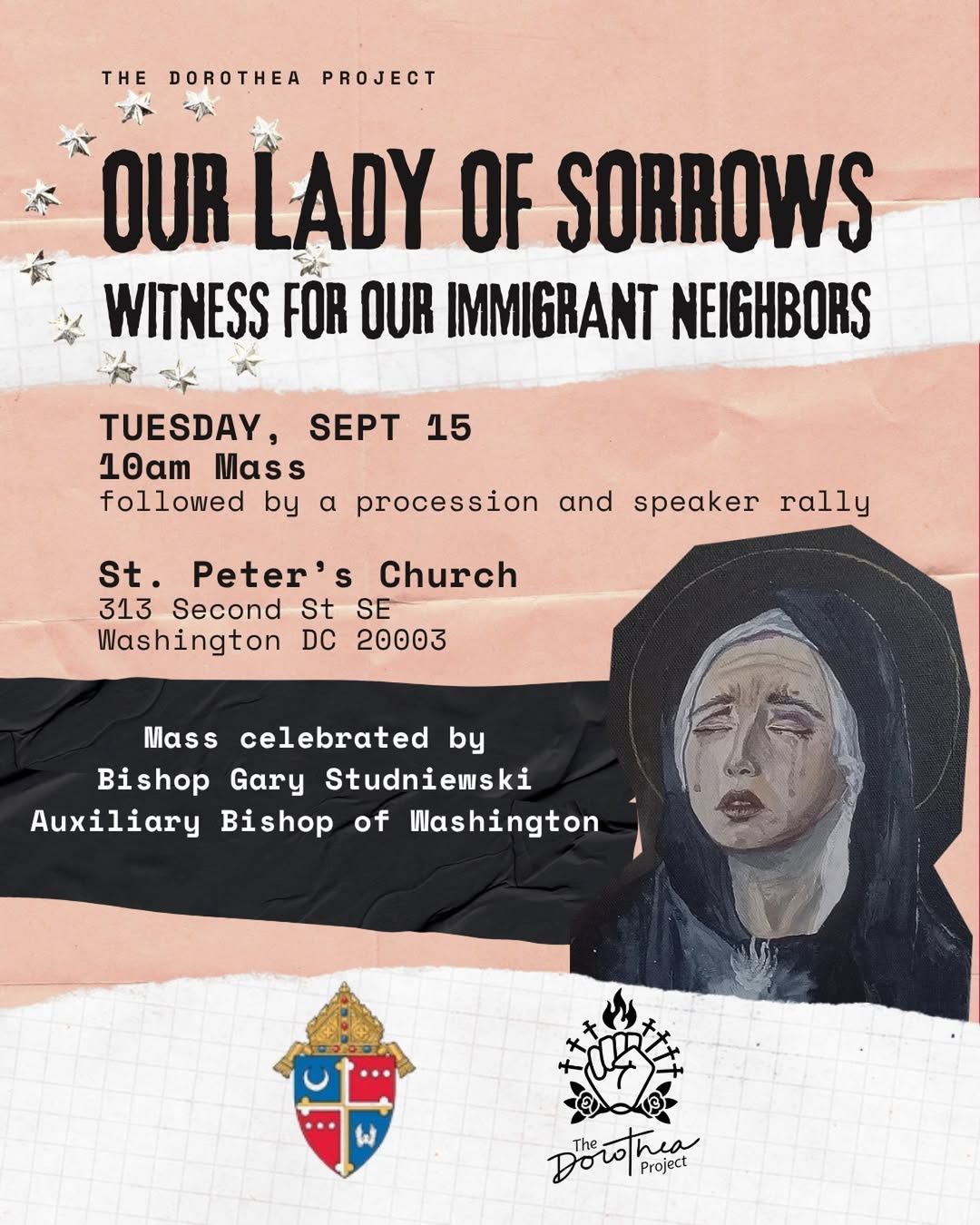
This liturgy, which will be presided over by Auxiliary Bishop Gary Studniewski, is organized as an expression of prayerful solidarity with immigrant communities who are currently experiencing dehumanizing treatment and rhetoric in the United States. The full program for the day includes a procession and rally as well as Holy Mass. To reserve a seat at St. Peter’s Church on Capitol Hill for the Mass, please RSVP here.
Two weeks later, in New York City, Robert Ellsberg will be offering a free lecture on Tuesday, September 29th, from 6:00-8:00 PM as part of The Village Trip annual festival. Robert’s talk, “Dorothy Day: A Radical Saint of the City,” will be held at the Jefferson Market Library, 425 6th Avenue. Learn more, and get your free tickets here.
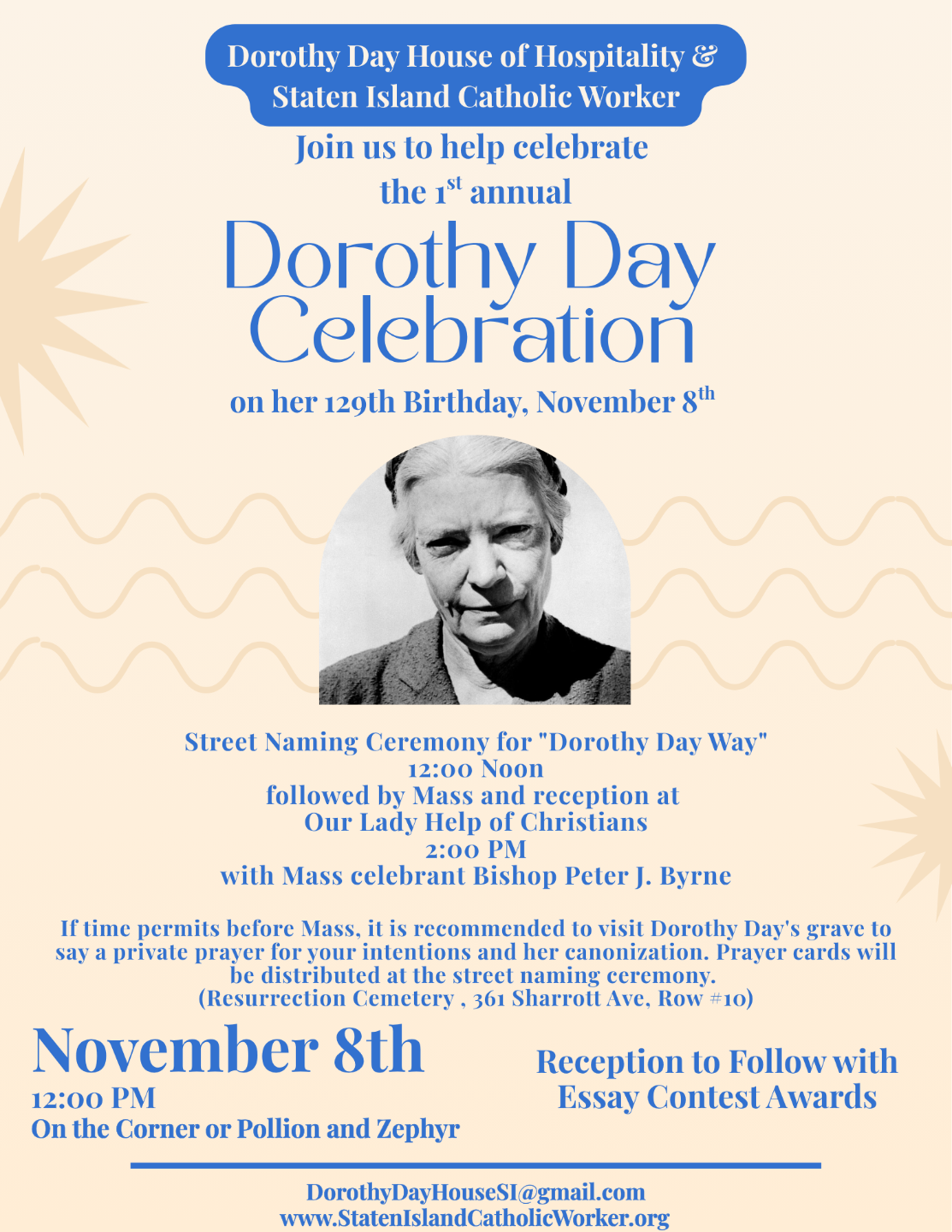
Finally, you are invited to join the Staten Island Catholic Worker community to celebrate Dorothy’s 129th birthday on Sunday, November 8th at 12:00 PM. The festivities begin with a street-naming ceremony for the new “Dorothy Day Way” on the corner of Staten Island’s Pollion and Zephyr at noon, followed by a 2:00 PM Mass and reception at Our Lady Help of Christians parish (where Dorothy was baptized in December of 1927).
Recordings of Dorothy in the American Voices Archive:
When our 2026 undergraduate research fellow, Analucia Romero, began working with the Guild and the Dorothy Day Center at the beginning of the summer, we explained that one of our goals was to build out the resources of the Guild’s online presence as a clearinghouse of information for students, scholars, and anyone interested in deepening their knowledge of Dorothy’s life and legacy of Gospel nonviolence, voluntary poverty, and hospitality. We are now in the process of assembling a dedicated page on our website as a research guide for high school and undergraduate students, but before that goes live, we wanted to share one of Analucia’s most exciting finds from the summer– an online collection of rare audio recordings of Dorothy’s speeches from the American Voice Archive!
The American Voice Archive,
“is a collection of late 19th and 20th century recordings, images and text that span the vista of American politics and culture… The voice recordings on this site remind us that these famous individuals were also living and breathing human beings who often expressed their thoughts with an emotional weight and dignity that is impossible to render on the written page.”
Dorothy’s contributions to this archive primarily come from the holdings of Marquette University, where her papers and those of the larger Catholic Worker movement are housed, but a readily-available, downloadable collection of her talks is a fantastic resource for anyone who would like to familiarize themselves with Dorothy’s living voice in the contexts where she spoke and taught throughout the 1960s and 1970s. We hope you will enjoy listening through a few of these varied conversations and recorded lectures!
Dorothy in the News:
We have a handful of recent news clippings, interviews, and podcasts related to Dorothy to share this month, including a forthcoming book by Pope Leo! Earlier this summer, the Vatican’s publishing house released a new collection of Pope Leo’s remarks on peace. It’s currently only available in Italian, but the English edition, entitled Disarmed and Disarming: Peace is a Gift is forthcoming.
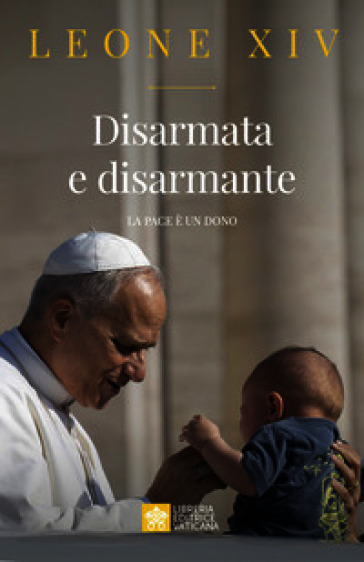
In the meantime, the previously unpublished foreword has been released in English, and we were so pleased to note that the Holy Father mentions Dorothy as one of the great witnesses to peace whose resistance to nuclear weapons will be discussed in greater detail in the anthology. You can read the foreword online, from the Vatican News. We’ll let you know as soon as the English-language edition of Disarmed and Disarming becomes available!
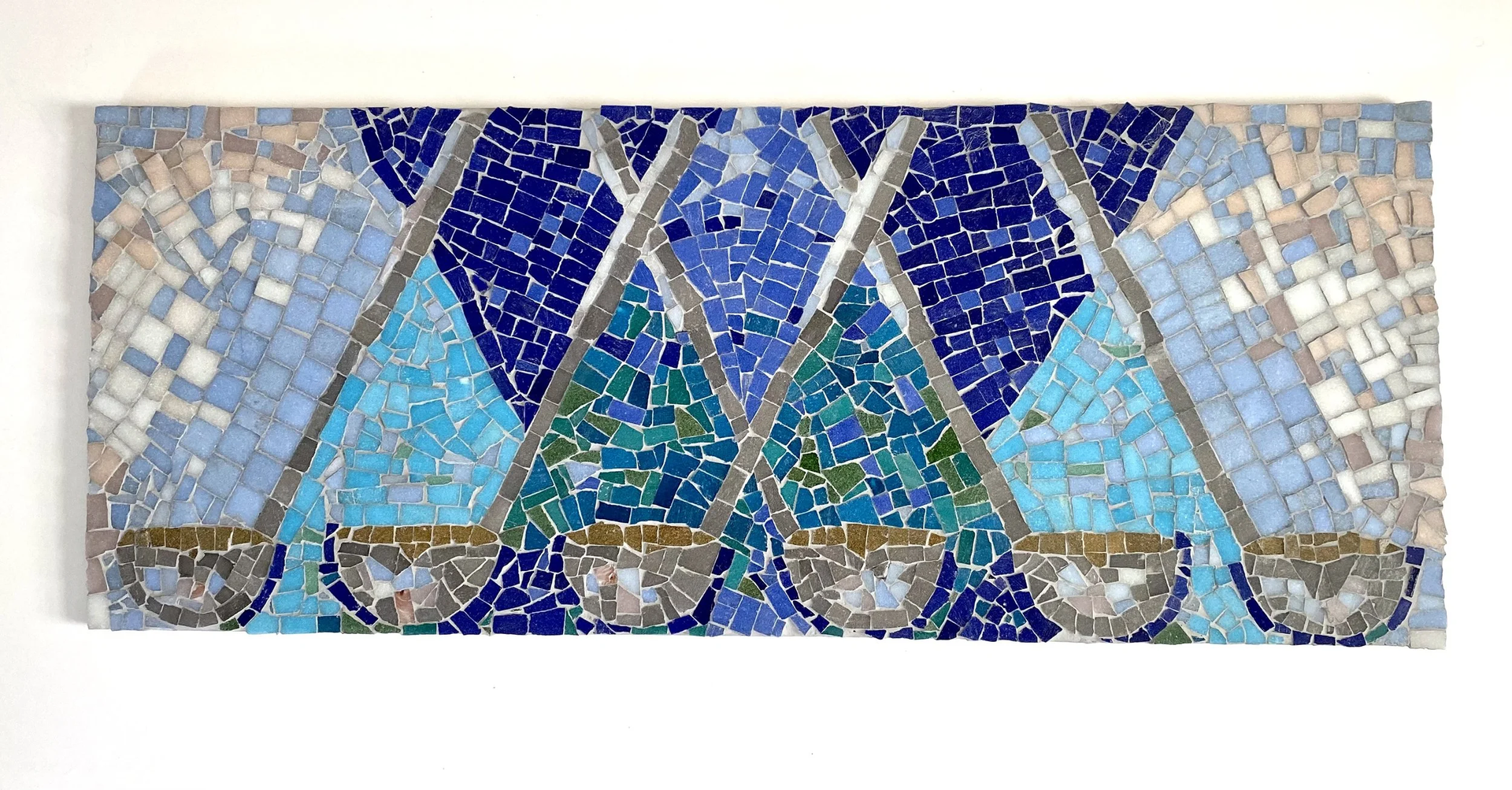
For the July issue of Plough, Stephen Adubato wrote “Dorothy Day: Finding Freedom in Obedience,” an exploration of the inherent, yet productive, tensions between the demands that both conscience and hierarchical authority assert in our lives. The article, which is illustrated by Kristi Pfister’s vibrant mosaics and paintings from her Radical Action: Tracing Dorothy Day installation, suggests that for Dorothy, “the relationship between obedience and freedom of conscience was less a deadlock ‘either-or’ between two opposing poles than it was a dance, a dynamic back-and-forth between two forces bound – with God’s grace – toward harmony.”
For America, Iowa-based columnist Nathan Beacom recently published a short take entitled “Socialism is back in style. Is today’s version compatible with Catholic social teaching?” which looks to Dorothy as an example of thoughtful political engagement in defense of “the rights and worth of working people.”
Finally, at the end of July, a reader sent us an episode of the
St. Anthony’s Tongue podcast, “The Dangerous Mysticism of Dorothy Day,” which situates Dorothy’s direct experience of God directly within her encounters with the poor: a grounded, Incarnational mysticism that finds God’s presence in the gutter as readily as on the altar. Judging from the majority of the comments, many of the
St. Anthony’s
readers and listeners were previously unfamiliar with Dorothy’s life and witness, so our thanks to founder W. Tyler Allen for bringing her legacy to a new audience!
A few words from Dorothy:
In the summer and early fall of 1970, Dorothy and her friend Eileen Egan embarked on a multi-continent learning and speaking tour which took them as far as Tanzania, where Dorothy was impressed with the African socialism of Julius Nyerere; India, where they spent time with Mother Teresa’s Missionaries of Charity; and Australia, where Dorothy spoke to a packed hall at Melbourne University on the evening of August 16th.
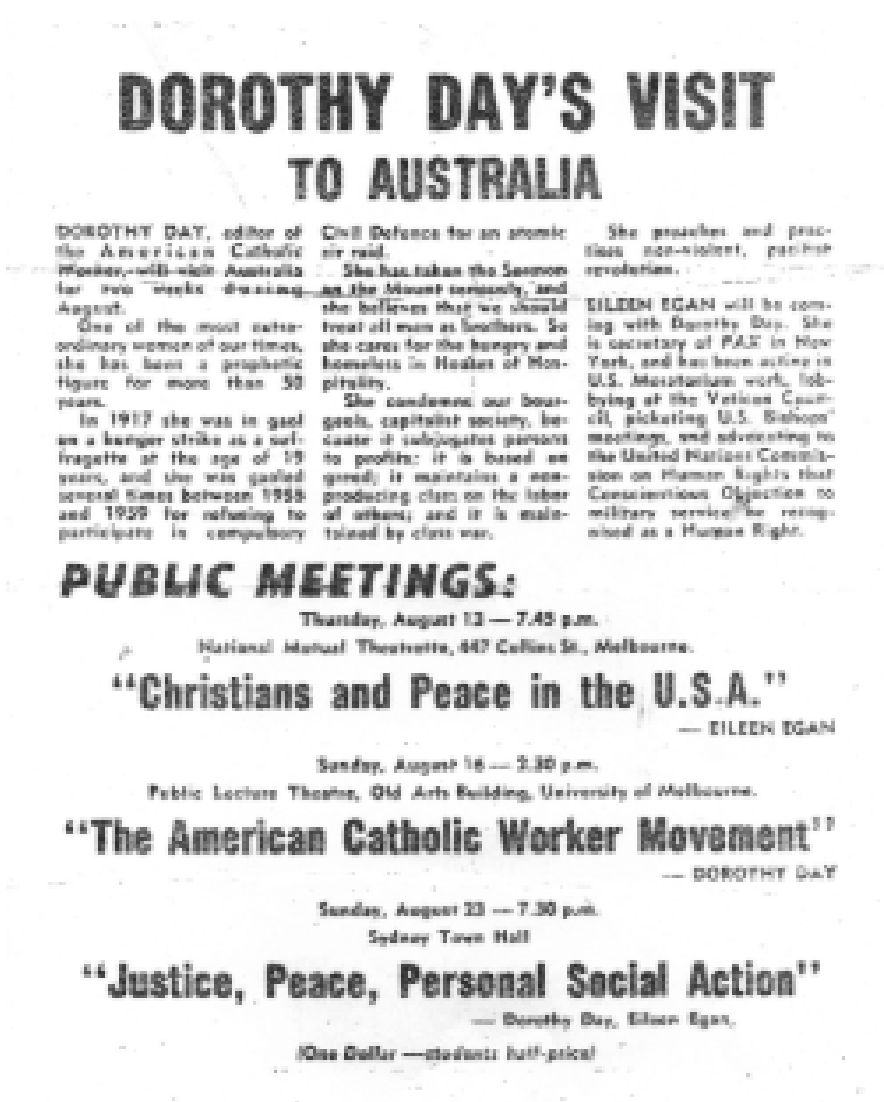
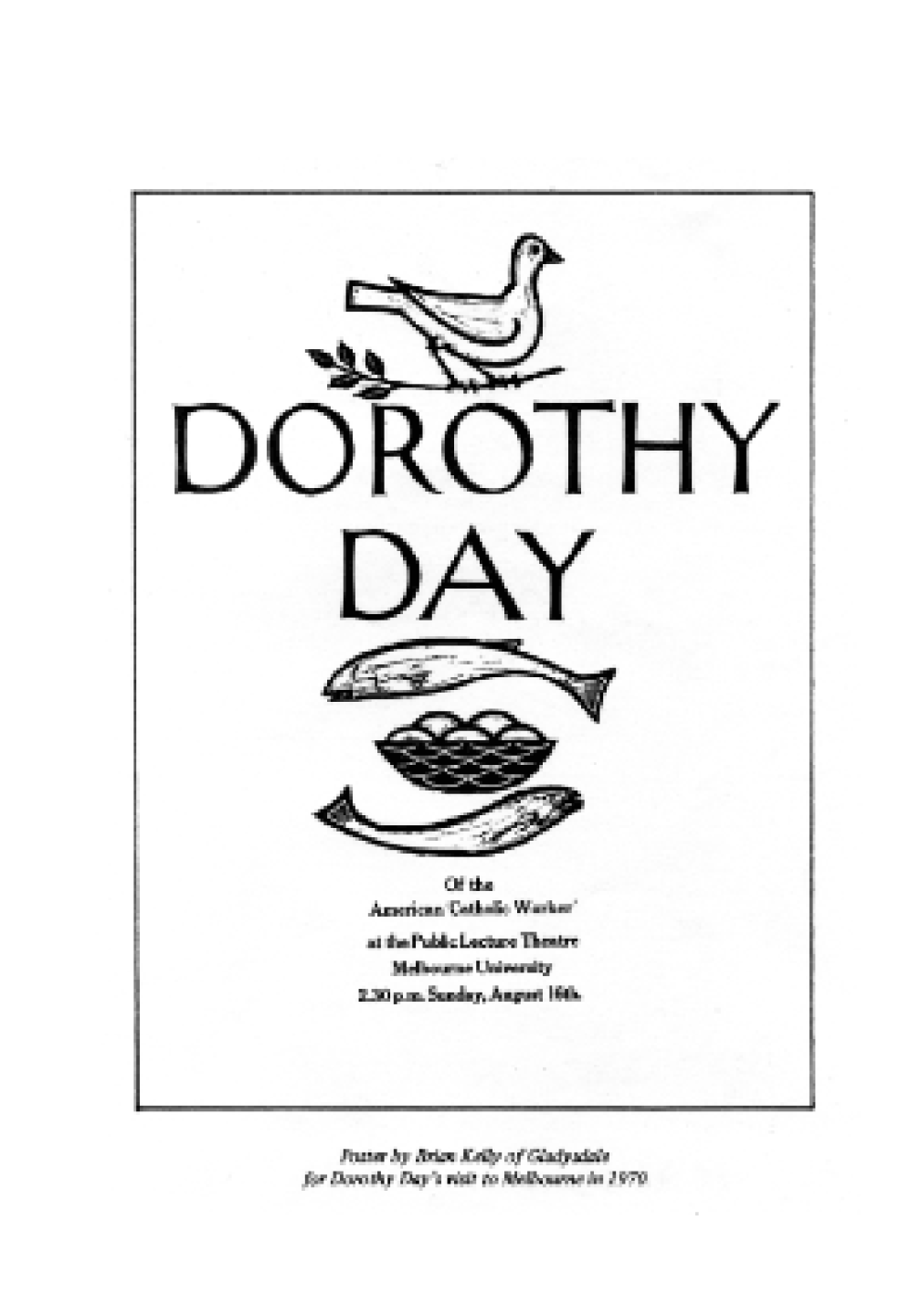
As part of her summer work for the Guild, Analucia Romero reached out to Australian historian and activist Val Noone, who had helped to organize the Australian leg of Dorothy and Eileen’s visit. Val’s brother, Brian, and future wife, Mary Doyle had by this point been running the first Australian “house of hospitality” in Melbourne for over a year, providing a home for otherwise unhoused men and sheltering Australian resisters to conscription during the Vietnam War.
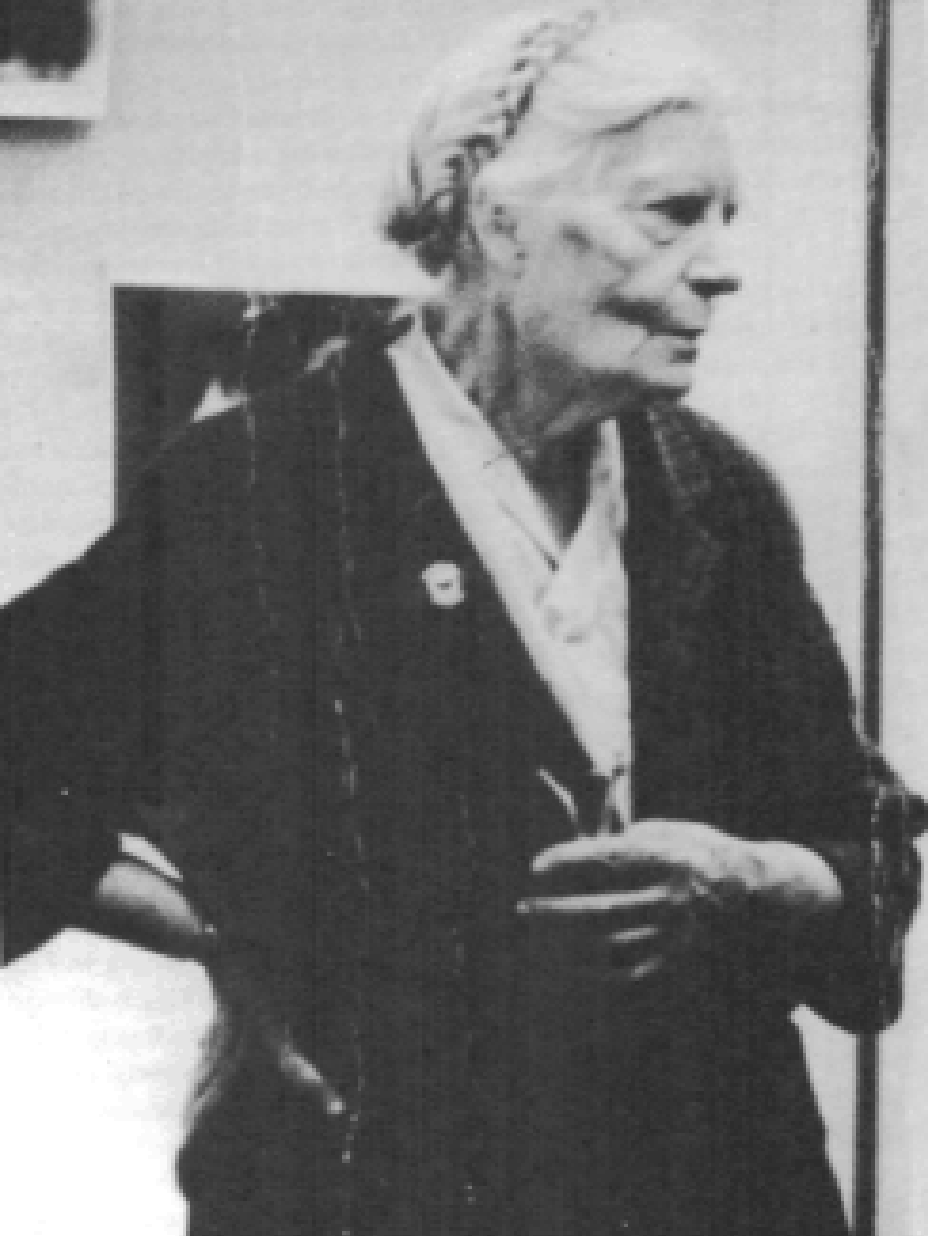
Val sent us copies of a few of the documents he had archived from that 1970 visit and which he had used in his 2020 book, Dorothy Day in Australia, a historical account of the influence of Dorothy’s Catholic pacifism and ideals of hospitality and voluntary poverty on the Australian Church from the late 20th-century forward. In this photograph, Dorothy is wearing a pin with the logo of the United Farm Workers, an effort she spoke of with great respect and admiration in her August 16th address, “The American Catholic Worker Movement.”
In honor of the anniversary of Dorothy and Eileen’s visit, we are very pleased to share with you the full audio recording of Dorothy’s talk, which Val recorded live on a borrowed reel-to-reel tape recorder and (much later) digitized. In this recording, Dorothy speaks for an hour, recounting the story of the Catholic Worker movement and its various characters and contributors up to that point. Afterwards, she takes questions from the audience for another fifty minutes, occasionally requiring some assistance with her interlocutors’ Australian accents!
We encourage you to listen to the entire recording– Kevin Ahern says that it is among his favorite of all of Dorothy’s recorded talks and interviews, and you really get a sense of her energy and sense of humor in her back-and-forth exchanges with the listeners. We wanted to share one section in particular, beginning at minute maker 21:38, that seemed especially relevant today, as our world is once again embroiled in a dispersed and piecemeal series of wars and armed conflicts.
“The second thing that Peter said was, in addition to voluntary poverty, was to– voluntary poverty meant that each one gave whatever he had, and whatever was lacking, the Lord would take care of it– but the second principle of reaching the man in the street, the man everywhere, was not just going out to the street, but the performance of the works of mercy…
The works of mercy, we keep pointing out, are the opposite of the works of war. Eileen Egan here once gave us a talk at the Catholic Worker, and that was the thing she brought out. We repeat it again, and again, and again. One of the young men who was a conscientious objector and went to jail a few years ago, finished his term and is now living up in the country in New York. He not only wrote an article about the works of mercy and the works of war, but one of the girls who was an illustrator, a mother of six children on our farm at Tivoli, she did the illustration of the works of mercy.
And the works of mercy, as we all know, from the twenty-fifth chapter of St. Matthew, are, well, how we will be judged. And they are feeding the hungry, clothing the naked, giving drinks to the thirsty, housing the homeless, visiting the sick, visiting the prisoner, visiting the dead. And the war, every war, every war we see prosecuted, is just exactly the opposite. And that is destroying the homes, destroying the food supplies by embargo, or by poisoning, or spraying. Everything is the opposite. Instead of visiting the sick, you’re filling the hospitals with people.
A friend of mine who has lost two sons back in Philadelphia, in the Vietnam War, is spending all her time now visiting the hospitals. And she says the mental hospitals are filling up; all the veterans’ hospitals are filling up, and there will be a need for the rest of our lives of visiting, visiting the hospital, visiting the sick, made this way by the wars we have been prosecuting. The works of mercy, you see, are direct action. They’re not waiting for some agency to take over; they’re not waiting until they have been processed, till they have been questioned. They are the immediate practice of the works of mercy. Direct action.”
So many of you, in houses of hospitality, in your parishes and schools, and in your own homes, have dedicated your lives to this form of direct action, and all of us here at the Guild would like to express our gratitude for these works of mercy. Please have no doubt that they are an effective means of building up God’s kingdom and creating a new society in the shell of the old. As Dorothy’s friend in Philadelphia noted, the need for your efforts is very great. This month, we pray that your own practice of the spiritual and corporal works of mercy would be strengthened and that many more people would be inspired by Dorothy’s example to turn away from the works of war in favor of these works of mercy which lead to peace.
Yours,
Dr. Casey Mullaney, on behalf of the Dorothy Day Guild
Share this post