Summer Greetings and Canonization Updates
Dear Dorothy Day Guild friends and members,
We hope that all of you are well, and for those in the United States, that you had a safe and happy July 4th weekend! Fifty years ago, for America’s Bicentennial anniversary, National Catholic Reporter included a six-page spread of greetings, poetry, and commentary from both ordinary and prominent American Catholics. Dorothy responded to their request for a quote with a one-word message to her country: “Repent.”

It was undoubtedly a difficult message to hear fifty years ago and may still be challenging now, when many of us here in the States spent the first part of this month enjoying fireworks and picnics, but it is the remark of a prophetic voice. We should remember that both the biblical prophets and those whom God has sent to us in our own time offer their message to us not to condemn or predict gloom and punishment, but rather to call their people back to His justice and the abundant life of His kingdom. The words of the prophets, from Amos and Isaiah to great Americans like Dr. Martin Luther King, Jr and Dorothy, are a gift, and we are heartened by so many friends who have taken up Dorothy’s challenge to turn away from the works of war and exclusion and dedicate their lives to the works of mercy and peace.
Canonization Updates:
First, we are very excited to share a brief canonization update with you! Our postulator in Rome, Dr. Waldery Hilgeman, recorded a video message for our members to share a progress report on the writing of Dorothy’s positio, the formal brief summarizing her life and presenting various testimonies and documents which speak to her heroic virtue.
The summary of witnesses and documents have both been concluded and is already approved by the Dicastery for Causes of the Saints. Dr. Hilgeman and his team have also completed Dorothy’s official biography, which has been presented to the Dicastery and awaits their approval. Currently, Dr. Hilgeman and his colleagues are at work on the informatio, the section of the positio which addresses Dorothy’s legacy, her heroic life, and additionally contains a record of all of the favors that were obtained by the faithful through her intercession. They hope to complete the positio in its entirety by the end of the summer and present the final version to the Dicastery by the close of 2026.
In addition to this update, we’d like to share a recent article that our former Guild coordinator, Jeffry Korgen, wrote for Roundtable on the earliest stages of the cause for Dorothy’s canonization. His piece, “How a Cardinal’s Dying Wish Kept the Door Open for Dorothy’s Sainthood,” traces the roots of the canonization cause to the 1997 meeting John Cardinal O’Connor held with a small group of Dorothy’s friends and fellow Catholic Workers to inquire about the possibility of opening a cause for canonization and the request he issued to Pope John Paul II to formally approve the legal start of the process in February of 2000. Jeffry writes,
“Almost three years later, shortly after O’Connor’s final visit, Pope John Paul II granted his second wish. About a month before the cardinal’s death on May 3, 2000, the Congregation for the Causes of Saints issued a nihil obstat (a “no objection” ruling) permitting Dorothy’s Cause for Beatification and Canonization to move forward. This was the one dying request the pope fulfilled for his friend and longtime supporter.”
Whether you are a newer friend or member of our Guild or if you’ve been part of the cause for now almost twenty years, Jeffry’s article is a fascinating historical retrospective on the sainthood process and the diverse group of lay Catholics and members of the hierarchy who have lent their gifts and their efforts to this work over the past two decades.
Recent News, Events, and Activities from the Dorothy Day Guild:
We’ve had a busy summer already and have lots of news and photos to share with you! Since May, we have hosted or partnered with friends in close to a dozen different events, both online, and in-person, in New York and the Midwest. Members of our Guild participated in a Corpus Christi procession, multiple walking pilgrimages, celebrations in Brooklyn and Albany, and a special exhibition marking the United States’ 250th birthday at the site of the only approved Marian apparition in this country. This has been a really exciting season for us, so read on for more details!
First, on May 2nd, the City of New York re-named the section of Brooklyn’s Pineapple Street, where Dorothy was born in 1897. This stretch is now known as “Dorothy Day Way”! We were so pleased to co-sponsor this event alongside Manhattan University’s Dorothy Day Center and the Brooklyn Oratory parishes, who hosted a dessert reception following the unveiling. Our special thanks go out to Guild board member Alex Avitabile, who was instrumental in advocating for this name change in Dorothy’s honor.
You can hear selections from some of the speeches given by Dr. Kevin Ahern, Martha Hennessy, Monsignor Ray Roden, and others and watch the actual street sign being unveiled in this video from the Catholic Faith Network and this one from Currents News.
Two weeks later, we hosted our annual Easter-season webinar, where we heard from four authors of recent biographies on Dorothy. If you missed it, or you’re looking for a recommendation for some summer reading, check out the recording on our YouTube channel.
We’ve also enjoyed several late spring and early summer walking pilgrimages. Mary Farrell, a member of the Winona, MN Catholic Worker community, sent several pictures of her pilgrimage group exploring lower Manhattan and praying at sites that were important to Dorothy, both in her early years and after her conversion and founding of the Catholic Worker movement.

We look forward to resuming our schedule of walking pilgrimages once the weather cools down towards the end of the summer, so stay tuned!

Later in May, members of our Guild were invited to Albany for a special proclamation of the New York State Senate sponsored by Senator Jessica Scarcella-Spanton and a bi-partisan group of sixty-two co-sponsors. The resolution, entitled “Commemorating the 45th Anniversary of the death of Dorothy Day, venerable Catholic lay leader, journalist, and co-founder of the Catholic Worker Movement” calls upon the legislative body to
“pause in its deliberations… to honor [Dorothy’s] profound contributions to social justice, peace, and the spiritual life of New York State and the nation, and to recognize the Catholic Worker of Staten Island for its efforts to preserve and celebrate her memory.”

Monsignor Kevin Sullivan opened the session with an invocation, which you can view here. The video of the senate session opens with Msgr. Sullivan’s prayer, and the introduction to the proclamation by Senator Scarcella-Spanton begins at the fourteen-minute mark. In her introduction, Scarcella-Spanton describes learning of a special mass commemorating Dorothy’s anniversary of death on November 29th, meeting members of the Staten Island Catholic Worker community, and beginning to read Dorothy’s memoirs and letters, coming to know Dorothy as a whole person rather than a two-dimensional caricature of sanctity. She said,
“Sometimes history gives us a version of a person which is polished and easy to digest, but the story I have learned recently about the woman that I admire and hope to see become a saint, was not simple at all. From the pages that make her come alive, Dorothy Day was dynamic, passionate, and deeply faithful, a person full of conviction, sacrifice, struggle, and love, and my personal favorite, sometimes contradiction, which whom amongst us isn’t? I have become fascinated by the layers and layers of what made Dorothy, Dorothy.”
Senator Jessica Ramos of Queens also spoke in favor of the resolution, noting that she keeps a photo of Dorothy in her family’s dining room as a reminder to her family and herself of their obligations towards the poor. Senator Rachel May, of the Syracuse area, offered her support as well, and spoke of Dorothy’s connections to Central New York through her work with Daniel and Phillip Berrigan and through the ongoing work of the Friends of Dorothy Day Catholic Worker community, which was opened in 1992 as a hospice for men who were dying of AIDS and had been abandoned by their families.
Senator Scarcella-Spanton also sent a special video message to friends and members of the Guild who weren’t able to attend the senate session, which you can view here.
On June 7th, members of the Guild joined other Catholic organizations from all over the New York Metro area for a Corpus Christi procession sponsored by the local chapter of Catholics in Communion. The pilgrimage, which was organized in solidarity with immigrant communities living in fear of deportation, began with Mass at St. Ignatius Loyola Church and included singing and prayer along the route to St. Francis de Sales Church, where the group enjoyed a celebratory, Latin American-inspired lunch in honor of the feast day.

Most recently, we were delighted to participate in the “Catholic Saints of America” exhibition at the National Shrine of Our Lady of Champion in Wisconsin in the first week of July. This exhibit took place as part of a nine-day program that included prayer opportunities, speakers, visits with representatives from more than 70 sainthood causes and shrines, and a picnic for the United States’ 250th anniversary.
David, one of our Board members, was present at the Shrine on Thursday and Friday of the program to introduce attendees to Dorothy’s life and her legacy of nonviolence, hospitality, and voluntary poverty. It was great to have so many people attend his Thursday and Friday talks and stop by for one of our Guild stickers and holy cards!
Our thanks to everyone who attended and worked so hard to organize such a meaningful slate of programs. We look forward to announcing our fall event schedule soon, so please keep an eye on our website and your inbox!

Welcome, Analucia!
Finally, if all of these events and activities weren’t enough, we are also excited to introduce you to our 2026 Dorothy Day Undergraduate Research Fellow, Analucia Romero.
Analucia is a rising junior at Baylor University in Waco, Texas, where she participates in the Great Texts program housed in the university’s Honors College. Analucia brings a host of skills and talents to the work of the Guild and to Manhattan University’s Dorothy Day Center this summer, including her dual-language fluency as a native Spanish speaker, social media and graphic design experience, and most importantly, a deep identification with Dorothy’s love for Christ in the poor.

For her fellowship, Analucia is working on social media outreach for the Guild as well as conducting primary-source research on Dorothy’s travels, particularly her 1970 international speaking tour with Eileen Egan and her 1963 visit to Danville, VA, where she was asked to speak at a civil rights meeting hosted by the High Street Baptist Church community and the following day participated in a demonstration alongside members the Student Nonviolent Coordinating Committee and several of Danville’s Black churches.
Analucia has spent time volunteering at the South Bend Catholic Worker and may already be a familiar face to many of you– she introduced our panel on Pope Leo’s first apostolic exhortation last spring, for our “Dorothy Day and Dilexi Te” webinar.
We’re very grateful to have her with us for the summer, and we look forward to sharing more of Analucia’s work with you in the coming months!
Dorothy in the News:
We are so pleased to share a number of recent news items and publications featuring Dorothy and the work of the Guild. First, like many of you, we were all absolutely thrilled to see Dorothy mentioned in Pope Leo’s new encyclical, Magnifica Humanitas, which was promulgated on May 15th, the 77th anniversary of Peter Maurin’s death. In paragraph 124, Pope Leo writes,
“Certain events make it clear that history can also change when individuals truly take the dignity of everyone seriously: the civil rights movement in the United States of America, closely associated with the testimony of Martin Luther King Jr., or the end of apartheid in South Africa following the release of Nelson Mandela and his decision not to surrender the future to hatred. In different contexts, many courageous and generous women have also stood out, including Saint Laura Montoya, Saint Teresa of Calcutta, Dorothy Day, Marie Skłodowska-Curie, Maria Montessori, Elisabeth Elliot, Wangari Maathai, Benazir Bhutto and countless others from every continent whose commitment has contributed to making history more humane.”
Much of the commentary around Magnifica Humanitas has focused on the Holy Father’s engagement with artificial intelligence, and while Catholic social teaching always addresses the “signs of the times,” these magisterial texts do so in order to point us back to deeper truths about humanity’s nature and relationships– with God, with one another, and with the Earth. Magnifica Humanitas invites us to consider questions of human flourishing and look to examples of brave and holy women and men, including Dorothy, who have devoted their lives to the establishment and safeguarding of the common good.
Have you read the Pope’s new encyclical yet? We’d love to hear your thoughts and reflections!
We would also like to share the great news that our friend Shannon Kleiber’s radio program, “On Pilgrimage with Dorothy Day,” won a Gabriel Award for “Best Audio Program or Show” at the annual Catholic Media Association conference last month! If you haven’t listened to Shannon’s audio documentary yet, we highly recommend it. We are honored that our Guild was able to participate in her phenomenal program!
For sixty years, the Gabriel Awards have drawn submissions from international film, television, and audio producers to “celebrate storytelling that reflects dignity, compassion, justice, community and tolerance.” They are among the most prestigious awards in the world of contemporary Catholic media. Congratulations to Shannon and her team on this well-deserved recognition!
Last, but certainly not least, we published the latest issue of In Our Time, the Dorothy Day Guild’s online periodical last month. This digital magazine is a rich resource, and truly a labor of love by our editor, Carolyn Zablotny. Many of our readers have already written to tell us how much they enjoyed receiving the periodical, which includes six original columns and an introductory letter from the editor. I’d like to briefly highlight just two columns here:
Mary Beth Becker’s “Saved by Beauty” column, “The Art of Possibility,” presents a statue of Dorothy that faces the entrance of St. Mary’s Church in Colt’s Neck, New Jersey and describes artist Brian Hanlon’s conceptual and technical processes of creating the sculpture. Art, in the Catholic Worker tradition, is a means of evangelization and a reflection of God’s own creativity. As Mary Beth writes,

“Statues and monuments reflect how we see ourselves, our aspirations, our values and what we as a society hold dear. In recent years, we have experienced as a nation an upheaval in our representation of history, culture and essential truths. But art will never be contained. It is resilient and emerges in unlikely places like the ailanthus trees that Dorothy wrote about in her journals. It has the capacity to illustrate the full human experience, to give voice to the marginalized and a face to the forgotten. Artists like Ade Bethune and the engraver Fritz Eichenberg revealed this in the pages of the Catholic Worker newspaper. Dorothy Day recognized art as one of the spiritual “weapons” along with direct action and the power of non-violence to move people, to arouse acts of conscience, and to change the social order.”
For this issue’s “Breaking Bread” column, “Life Lessons,” Sal Rosselli spoke about how his time at St. Joseph House in New York, where he worked alongside Dorothy in 1969, helped him discover his vocation as a labor organizer.
“I loved it from the start. Every day, I woke up at 5 a.m. and chopped vegetables to feed hundreds of people. Later in the day I’d sell the Catholic Worker paper outside St. Patrick’s Cathedral. It only cost a penny.
There’s a famous scene in The Karate Kid where Daniel expects Mr. Miyagi to teach him karate, but instead Miyagi makes him spend days painting his house, waxing his car, and sanding his floors. It’s only later that Daniel realizes that the work not only helped him develop patience and trust, but that the movements he learned through that manual labor were the building blocks of karate.
That’s how I look back on my months at St. Joseph’s House on the Bowery. Technically, I was chopping vegetables and feeding the poor. In reality, I was developing a moral code; grasping what service leadership is all about; and starting to understand what really mattered in life.
And I learned it all from Dorothy Day.”
Dorothy and Peter often spoke of the Catholic Worker as a school, and Dorothy in particular had a great gift for helping others discover their own vocations. What Sal, who later went on to found the National Union of Healthcare Workers, describes here is an incredible example of the ways in which the daily offering of the works of mercy and the practices of hospitality can form and shape us, stretching our God-given gifts and capacities and opening our eyes to how God might be calling us to further service “building the new society in the shell of the old.”

Huge thanks to Carolyn, Mindy, Vanessa, and all of the authors and artists who contributed to this most recent edition of In Our Time! We’re already eagerly anticipating the fall issue!
Additional Reading and Listening Recommendations:
In May, we wrote to you about the new La Sagrada Familia Catholic Worker house in Keene, New Hampshire. In addition to their hospitality work, La Sagrada Familia also hosts a podcast series, Religious Life, as a way of offering thoughtful conversations on issues of immigration, incarceration, nonviolence, and Gospel teachings around sharing wealth to help listeners deepen their baptismal commitments and live out the hospitality that the Holy Family models for us. Robert Ellsberg was a recent podcast guest, and his conversation with Duncan Hilton and Emily Dube touches on several different aspects of Dorothy’s witness in the Church and in our culture. Speaking on Dorothy’s pacifism, Robert said,
“I think the essential foundation of Dorothy’s life and spirituality came from her understanding of the radical implications of the Incarnation…We don’t just worship Christ in heaven somewhere, but Jesus is calling our attention to the people all around us, and the world that we live in, and saying ‘Don’t look for me here, there, or up in the sky or something like that, or just in church. Look at me, and find me in the needs of your neighbors, your brothers and sisters, and particularly in the idea that finding God in the disguise of our neighbor, even in the terrible disguise of the one called an enemy. She believed that the Gospel, that the example of Jesus, was an example of nonviolence.”
Thanks, Robert, Duncan, and Emily for facilitating this engaging and enlightening conversation! You can listen to this episode, “‘Utter Trust in God’: Robert Ellsberg on Dorothy Day and the Lives of the Saints” and other episodes of the Religious Life podcast on La Sagrada Familia’s website.
In May, Brian Terrell of Strangers and Guests Catholic Worker Farm in Iowa, published a piece for Roundtable, “Dorothy Day and the Woodstock Generation.” Brian’s reflections on Dorothy’s respect for the work and viewpoints of the young even into her own seventies and eighties are gleaned from her letters and diaries as well as his own experiences of working alongside her in his late teens and early twenties. In the photo below, Brian, Robert Ellsberg (far left, middle two rows!) and many other young activists are pictured protesting nuclear weapons development in Rocky Flats, Colorado, an act which Dorothy praised and recognized as a spiritual work of mercy in her June 1978 column.

Dorothy could be critical, too, but that criticism was always directed first at her own heart, which she examined daily in an ongoing practice of turning back to God and asking to be conformed to Christ, who reminded his disciples to “Judge not.”
This is really an excellent piece, both in terms of its historical vantage point and its contemporary approach. Brian has himself now spent as much of his life as a Catholic Worker as Dorothy did, and his perspective on the intergenerational continuity and collaboration within the movement is a reminder of the Holy Spirit’s constant presence, renewing and sustaining the Body of Christ at work in the world.
At the end of May, Elizabeth Bolchoz Stanford published “Dorothy Day and Democracy in America,” a piece that engages Alexis de Toqueville’s five principles of democracy as a secular lens for reading the political theory that underlies Dorothy and Peter’s political theory. Writing on de Toqueville’s first principle, liberty, Elizabeth notes that,
“The entirety of the Catholic Worker Movement is dependent on freedom…Furthermore, to Tocqueville’s point, Day formed the Catholic Worker Movement as an effort to demonstrate this ‘apprenticeship’ of being free. In her 1966 Advent reflection, Dorothy Day wrote about the ‘tremendous freedom there is in the Church.’ As she explained, “For those who live in Christ Jesus, for those who have put on Christ, for those who have washed the feet of others, there is no law. They have the liberty of the children of God.” The emphasis here is not on one’s freedom to act against moral law or to infringe upon civil order and the common good. Rather, as she quotes from Persona Humana, ‘In the depths of his conscience man detects a law which he does not impose on himself, but which holds him to obedience. . . . For man has in his heart a law written by God.’”
While it remains impossible to entirely map Dorothy’s understanding of the role of the person and small voluntary associations, such as Catholic Worker communities, labor guilds, and communal farms vis-a-vis any existing political theory, our members will appreciate Elizabeth’s careful engagement with de Toqueville as a contemporary example of clarification of thought!
Early in June, Dr. Kevin Ahern participated in a webinar hosted by the Pax Christi New England Campaign to Abolish Nuclear Weapons and Back from the Brink along with fellow panelists Bishop John Stowe, Dr. Maryann Cusimano Love of Catholic University, Dan Moriarity, of Maryknoll’s Office for Global Concerns, and Archbishop John Wester.
Every one of these panelists brought concrete proposals for how both lay men and women and members of our Church’s hierarchy can lead Catholic and ecumenical efforts for genuine nuclear disarmament and the promotion of true peace in our world today. Not surprisingly, Dorothy’s name came up several times!
We strongly recommend listening to or watching the whole panel, but members of our Guild will likely be particularly interested in Kevin’s presentation segment, “A Saint for Nuclear Abolition,” which begins at minute marker 40:54.
Kevin speaks about Dorothy as a bridge figure for young Catholics, who may be concerned about peace and justice generally, but who haven’t been exposed to the Church’s teachings on nuclear disarmament. He describes introducing students to Dorothy as a patroness of nuclear abolition and how his students are often surprised to encounter Dorothy in her own words on this issue. In his classes, one of the most shocking moments for students is Dorothy’s September 1945 column, “We Go On Record,” in response to the US bombing of Hiroshima and Nagasaki.
“Here Dorothy is in her classic style, very very prophetic in her. [It] jumps off the page. Right? So one of the things this says to me, and young people when they read this are like ‘I can't believe she's saying this in this way.’ And ‘is she really equating the bomb with the Antichrist?’ Because she situates the bomb as sort of the opposite of Jesus: born in a cave under New York City, she says; tried in the desert. She situates the bomb as sort of the antithesis of Jesus.
And the students can't believe this, right? And they can't believe that an American woman writing in 1945 is going to be critical of the US government. So it sort of shakes them, but it inspires them and they start asking why what's going on here. So I think when we think about saints, when we think about holiness, when we think about the holiness as a response to this terrible work of death in our world, we have to think about saintliness and holiness as prophetic. Prophetic as a denunciation of the evil, and as announcing something else, something good.”
This panel (and all the conversations in this series) make excellent teaching resources for parish, classroom, or personal formation, and we encourage you to watch the other three summits and participate in their call to action this summer!
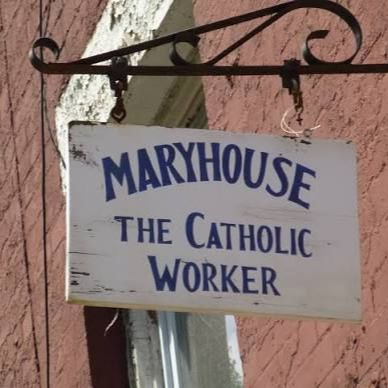
Also last month, Martha Hennessy met with Camillo Barone, a reporter for National Catholic Reporter and took him to Maryhouse and her grandmother’s burial place in Staten Island’s Resurrection Cemetery. Their conversation touched on Dorothy’s recognition in Pope Leo’s Magnifica Humanitas, the Church’s synodality process and the Catholic Worker as a model, nuclear disarmament, and Dorothy’s canonization process.
"’Dorothy was a single working mother in the 1920s, which was unheard of. She gives young women inspiration. She is such an example of courage, fearlessness.’
The same is true, Hennessy believes, for the American Catholic Church in general. "This is why the canonization cause is so critical," she said. ‘She is a perfect saint for the U.S. Catholic Church.’”
Martha also shared some family photographs with NCR, including this one, with her parents, aunt, grandmother, brother, and close family friend and lifelong Catholic Worker Stanley Vishnewski.

Thanks, Martha, for sharing these personal reflections and memories, and for carrying Dorothy’s peace witness forward! You can read the entire article, “Sitting by Dorothy Day's grave, her granddaughter reflects on faith, family and war,” on the National Catholic Reporter website.
In the June/July issue of America, Renée Roden published an article featuring several contemporary Catholic Worker artists and their work as a significant contribution to not just the aesthetics, but the entire set of practices which characterize the Catholic Worker movement. In “Laboring for Beauty: The Tradition of Catholic Worker Art,” Art has played a major role in the Catholic Worker tradition since the 1930s, with works by Ade Bethune and Fritz Eichenberg illustrating the earliest issues of the newspaper. For this piece, Renée visits with newer Catholic Worker printmakers, iconographers, and muralists including Emma Coley Fitzgerald, Dmitri Kadiev, Becky McIntyre, and Sarah Fuller, as well as long-time artists such as Willa Bickham, whose work has graced Catholic Worker houses and newsletters for decades. Speaking with Becky McIntyre in Philadelphia on the function of art within Catholic Worker praxis, she notes,
“To McIntyre, Catholic Worker art is not just about making a community visible to itself and others; it is about making the philosophy of the movement accessible, graspable. She highlighted Bethune’s first encounter with Dorothy. ‘Ade’s desire to accompany the words of the newspaper with art,” she said, contains the work of all Catholic Worker artists, to “capture the work of the movement and the values of the movement visually,’ she said.
‘Theoretically, Catholic Worker art lets people enter into the fluffy theological things and enter into it differently,’ McIntyre said, to access abstract ideas concretely. ‘It invites us into imagining together—to help us see the world we want to live and create,’ she added.”
You can read Renée’s article in pdf format here, and for those interested in learning more about this aspect of the Catholic Worker tradition, we invite you to check out our 2024 Easter webinar, “Art, Hospitality, and Activism" featuring Sarah Fuller, Becky McIntyre, and Rachel Mills.
News from our friends:
We also have two recent articles to share about friends of the Dorothy Day Guild, individuals and organizations whose work in the world mirrors and is inspired by Dorothy’s own legacy of nonviolence, voluntary poverty, and hospitality.
First, from Maryknoll Magazine, this article, “Maryknoll Shelter in Taiwan Offers Refuge to Migrant Workers,” details the ministry of Fr. Joyalito Tajonera, a Maryknoll priest and member of our Guild’s advisory committee who runs a house of hospitality serving a community of Filipino migrant workers and advocates for labor justice in the context of a deeply exploitative economic system. Journalist Paul Jeffrey writes,
“The shelter reflects [Fr. Joyalito’s] exposure to the Catholic Worker in New York City, where he lived for several years before entering the Maryknoll Fathers and Brothers.
‘The spirit of Dorothy Day is alive and well here,’ Father Tajonera says. ‘There are no managers and bosses here. Everybody helps. Everybody becomes a mentor of the newly arrived, and they work together, they learn from one another. The migrants themselves become their own advocates because they learn from their experience and they share that experience with others.’”
Ugnayan, the name of the house of hospitality, comes from the Filipino word meaning “connection” or “relationship.” The house offers a wide range of support for the migrant workers, who are far from their families of origin and are vulnerable to exploitation, yet as is the case in Catholic Worker communities around the world, are able to form a new family here based on solidarity, friendship, and mutual aid. You can read a version of this article in Maryknoll’s Spanish-language magazine, Misoneros, here.
We also loved this article, “Meet the Catholic mom organizing for immigrant advocacy,” on the work of the Dorothea Project, from US Catholic, published at the end of June. Katie Holler is the founder of the Dorothea Project, a group of over a thousand Catholic women, many of them young mothers, who regularly meet online for discussion and self-education on Catholic social teaching and contemporary issues affecting the Church. The group also works to organize their own social circles and parishes for action, most recently on justice for immigrants. The Dorothea Project is named for both Dorothy and Venerable Sister Thea Bowman, both converts to Catholicism and lifelong advocates for the poor and vulnerable. According to Holler,
“The Dorothea Project has also deepened and transformed her own faith. In a very short time, she’s met scores of Catholic women with varying faith experiences and backgrounds. ‘It’s shaped my understanding of what it means to be a Catholic and given me a community where I feel connected to the universal church in a very new and powerful way,’ she says.
Empowered by her baptism to lead, she now feels a responsibility to ‘be more prayerful, more intentional, and more connected to the Lord,“ she says. “All the women who came together to found the Dorothea Project share the desire to be ‘Spirit-guided and Spirit-led.’”
Many thanks to the members of the Dorothea Project for their prophetic work in our Church! You can learn more about the Dorothea Project and become involved in their formation and activism by visiting their website.
In memoriam:
This month, please join us in remembering and praying for two members of our extended community who have recently died. Maggie Hennessy, Dorothy’s sixth grandchild, passed away on June 15th at the age of 72. Like all of Tamar’s children, Maggie was raised with a deep love for the earth and spent much of her early years at the Tivoli Catholic Worker farm, where she met her long-time partner, the father of her two sons. Her sister Martha shared these photographs of Maggie at Tivoli, carding wool and preparing for a trip along with their older sister, Susie, their niece Tanya, Dorothy, and Cliff Lichter, a family friend and member of the Catholic Worker community for many years. Maggie combined a deep sense of rootedness with a love for travel, adventure, and encounters with new cultures and communities. Martha fondly remembers Dorothy sending them to visit friends in Spain together in their late teens.


Maggie and her partner were among the first to take up the call of the back-to-the-land movement and settled in West Virginia where they established a homestead. Maggie remained in her beloved Lincoln County for the rest of her life, eventually becoming a registered nurse in order to better care for her elderly neighbors. Her love for nature remained a guiding principle for her life from childhood until her last days, and her family has requested that any friends wishing to honor her make a memorial contribution to the Cornell Lab of Ornithology in Maggie’s name.
We also remember Robert Coles, one of Dorothy’s early biographers, who died on June 4th at the age of 97. Robert was a child psychiatrist, ally to the Civil Rights movement, and professor at Harvard University, where Robert Ellsberg was among the many students he advised. In his book on the Catholic Worker movement, A Spectacle Unto the World, he states that he and his wife first heard of Dorothy and the Catholic Worker movement through civil rights workers in the South, where they lived and served for many years. He later visited Dorothy in New York and was deeply moved by her spirituality and commitment to the poor.
In 1983, Robert Ellsberg interviewed Dr. Coles for The Catholic Agitator, the newspaper of the Los Angeles Catholic Worker community. Their conversation touched on the question of voluntary poverty. Reflecting on the possibility of true solidarity with the poor, Robert Ellsberg noted that “Even Dorothy said that she couldn’t really experience the poverty of someone who had no choice.” Dr. Coles responded, “But she put herself on the Bowery. I think about what this means. I think about Christ and what it means that he was willing to assume the cross.” For him, Dorothy’s faith took on the character of kenosis; it was an imitation of Jesus’ self-emptying gift to humankind.


As we remember Robert and Maggie, all of us at the Guild would like to express our gratitude for the gift of their lives and their many contributions to the common good, especially in service to the poor.
Prayer requests:
Intercessory prayer, the practice of asking Dorothy’s assistance in bringing our needs and concerns before God, continues to be an important work of our Guild membership. In the first part of the summer, we’ve received several requests for which we ask you to join us (and Dorothy) in prayer.
First, Clifton, from Plattsburgh, NY asked us to pray for a happy death. We ask that at the eventual end of his life that he be granted the grace of deep faith and be surrounded by the companionship of his loved ones and family members, living and dead. Thank you, Clifton, for submitting this request, which is such a beautiful reminder of our ongoing participation in the communion of saints!
Ellen from Minnesota has requested that we ask Dorothy’s prayers for the health of her lungs and for an end to the bronchiectasis flares she has been experiencing. She has also asked for protection from infection and disease in the coming months. Please join us in praying for her healing and comfort this summer.
We are now in the peak of wildfire season for the Southwestern United States, and Judith has written to us from Colorado to ask for Dorothy’s intercession for the forest fires in the southwestern part of her state and southern Utah. Knowing of Dorothy’s deep love for and solidarity with both Creation and laboring men and women, please pray for the fires to abate and for the safety of all the firefighters and the entire ecosystem they are working to protect.
We were deeply saddened to hear the news that John Ahern, father of our Dorothy Day Guild chair, Dr. Kevin Ahern, died on Monday, a few days shy of his 95th birthday. John was a devoted husband, father, and grandfather and avid supporter of the Catholic Worker movement. Please join us in praying for the repose of his soul and the comfort of his family.
Finally, please join us in praying for a dear friend of the Guild, Patrick, who is currently recovering from a stroke and a series of dangerous infections in North Carolina. Patrick is a long-time Catholic Worker and Plowshares activist, and his family has asked for Dorothy’s intercession for his healing. Please join us in asking God to bring strength and comfort to Patrick and his family, especially his wife Mary, and to continue guiding the medical team who have accompanied him so skillfully over the past several months. Patrick and his family have faced this entire series of challenges with incredible grace and good humor, and we know that Dorothy has been among the great cloud of witnesses who have uplifted and sustained them since his initial stroke. Please continue to pray for Patrick’s good health in the days and weeks ahead!
A few words from Dorothy:
While working with Analucia on her research into Dorothy’s involvement with the Civil Rights movement, Kevin Ahern and I have been re-reading Dorothy’s July/August 1963 column, where she details her time in Danville, Virginia. Dorothy went to Virginia at the request of Mother Teresa, one of the founding members and the superior of the Society of Christ Our King, an apostolic congregation of sisters dedicated to evangelization and social service to the poor, regardless of race. Mother Teresa had been an open supporter of the Civil Rights movement and had spoken out on the radio several times and had participated in previous demonstrations. Danville’s Catholic population was small, with only one parish, headed by a priest who threatened to place Mother Teresa under interdict and report her to the bishop if she continued to participate in racially-integrated marches and protests. Mother Teresa, who had known Dorothy for many years, asked Dorothy to come down and speak in her place at an upcoming mass meeting.
The night before the rally, Dorothy had dinner with a group of young activists from the Student Nonviolent Coordinating Committee, who told her about a demonstration that had turned into a riot the previous week, when a group of police deputies kettled the marchers in a narrow alley, turned fire hoses on them, and brutally beat the demonstrators. Two remained hospitalized the night of Dorothy’s arrival in Danville.
The following day, Dorothy was asked to be the closing speaker at the mass meeting hosted by the High Street Baptist Church, a hotbed of Civil Rights activism. After opening prayers and hymns and several other speakers, Dorothy told her listeners about Pope John XXIII’s new encyclical, Pacem in Terris. She told her audience,
“that after so many years of work in the Peace Movement, I had come to the conclusion that basic to peace was this struggle of the colored for education, job opportunity, health, and recognition as men. That while we talked of averting war, we were in the midst of one of the strangest wars in history, where the side which had declared the war were using no weapons but those of suffering. They were praying they were marching they were doing without (by boycott); they were in a way offering their own flesh, their suffering, their imprisonment, for their brothers. “A new commandment” (not a counsel) “I give to you, that you love each other as I have loved you.” And that commandment of Jesus means the laying down of life itself for one’s brother, colored and white.
It is the Negro who is leading the way, and it is among the Negroes that the ranks of the martyrs is increasing. They are uncounted, unknown, many of them. Medgar Evers leads them, going out as he did with fore knowledge of his doom. He fell, and his brother is taking his place. Others are unknown, unsung heroes. Something is happening in our midst that we do not recognize. We have eyes and see not, ears and hear not. The last are becoming the first. “He hath put down the mighty from their seat and hath exalted the humble.”
As we mark the 250th birthday of the United States this month and the anniversary of Dorothy’s visit to Danville, which took place from July 8th-10th of 1963, those of us in the US have heard many reminders of our country’s values and traditions, the most prized of which is freedom. But freedom is gained through struggle and sacrifice, as Dorothy reminds us. She refers to Medgar Evers and the uncounted heroes of the Civil Rights movement as martyrs, and disciples of Jesus, who have obeyed his command to imitate his love. The ongoing legacy of the Civil Rights movement reminds us that true peace and true freedom are only achieved when racial equality is, too. The freedom, peace, and equality won for us by the men, women, and children Dorothy broke bread with, spoke to, prayed with, and marched alongside in Danville and all across the American South during those years is a prophetic sign that what God promised to Mary in her Magnificat– that the He will cast down the mighty and lift up the humble– “is happening in our midst.” This month, please join us, and Dorothy, in honoring the Civil Rights workers of Danville, VA, and thanking God for their courage and generosity of spirit in laying down their lives for the freedom of their brothers and sisters.
In peace,
Dr. Casey Mullaney, on behalf of the Dorothy Day Guild
Share this post