A Precocious Conscience
We’re happy this issue to bring you a new column, Kaleidoscope, dedicated to looking at Dorothy’s take on perennially insistent questions
of conscience.
From the beginning, starting that very first morning in Catholic grade school, I pledged allegiance to the flag aside my not yet christened “Boomer” classmates. And every noontime, we piled into pews for Mass. Patriot and saint were rolled up into one glorious perfection. It wasn’t long before Abraham Lincoln became my hallowed hero.
Ours was still a time of The Baltimore Catechism, the standard Catholic religious curriculum in the United States for decades. It took the form of questions and answers, and we memorized and recited out loud its certainties. The Catechism defined conscience as the “voice of God” or an inner “judgment of reason” that helps a person recognize whether an action is right or wrong in accordance with God’s law.
For me, as for many of us, the closest I came to the voice of God was through a nun/teacher. In my case, it was Sr. Mary Louis Anthony who taught history. I’m sure she never meant to trigger my first loss of faith.
We were studying the Civil War. Right before the class’s end, she tossed out, almost as an aside, in a matter- of- fact voice, "Oh, and Lincoln, by the way, in order to hasten the end of the war, strictly forbade the shipment of morphine to the wounded Southern troops. They had nothing to minimize their pain. He hoped their increased suffering would help to bring the Confederacy to its knees."
Then, almost simultaneous with the delivery of this salvo to my moral universe, the dismissal bell rang. Kids rushed past me out the door. I wanted to yell, “stop, I need help!” But in a matter of seconds, I was alone, my heart bursting in my head.
That Lincoln the Compassionate would ever do such a thing was totally unthinkable, impossible, heretical! Slowly, shakily, I got up. Sr. Mary Louis Anthony was still sitting behind her desk, totally unaware of the maelstrom of emotion in me. I wish I could have told her how hurt and betrayed I felt. Instead, I said with a self-protective, challenging aloofness, that I didn't believe her, that I didn't believe Lincoln would do that. "You can think what you want," she said tersely, "but it's true."
I slinked away, embarrassed at not even twelve, by what I deemed disparagingly my “idealism.”
What a great grace it was, a few years later, to have my sweet older sister bring home a copy of Dorothy Day’s spiritual autobiography, The Long Loneliness, as a gift for my mother! Whether it was the title or her excitement (“this is by a laywoman!”), or both, I tried to read it too. Much eluded me, but her yearning for goodness I could feel.
Toward the end of her life, Dorothy famously said to child psychiatrist and author Robert Coles, who penned a biography of her, that if she had accomplished anything in her life, it was because she hadn't been embarrassed to talk about God. Unlike me, she also wasn't embarrassed to talk about conscience and ideals. Or disillusionment.
I once had the privilege of interviewing Coles, sitting in his Harvard office and talking about the many experiences that shaped Dorothy’s conscience. He cited the importance of her writing and placed her squarely in the documentary tradition. And, referring laughingly to his psychoanalytic hat, he suggested she probably had as a child what he called a “precocious” conscience.
“She hadn't been embarrassed to talk about God. Unlike me, she also wasn't embarrassed to talk about conscience and ideals.”
Born in the same decade as George Orwell and John Steinbeck, who like her would come to direct the world’s gaze on the forgotten and the abused, Dorothy’s searching youth was characterized by a keen sensitivity to suffering.
Her nominally Protestant parents instilled little faith but “a sense of right and wrong” and the presence of something omniscient, which she called “God.”
We did not search for God when we were children. We took Him for granted.
We were at some time taught to say our evening prayers. "Now I lay me," and
"Bless my father and mother." This done, we prayed no more.
It was the San Francisco earthquake of 1906 that imprinted itself more than any religion on her eight-year-old conscience. Her family had moved to the West Coast from New York, following the career of her sportswriter father. She experienced what writer Rebecca Solnit would later categorize as an “uprising of new and equalized social networks.” Day vividly remembered, “All the neighbors joined my mother in serving the homeless.”
Since her father’s newspaper office was completely levelled, the family had to move again, this time to Chicago. There she discovered the muckraking journalism of Jack London and Upton Sinclair and read The Jungle, capturing the appalling conditions of workers in Chicago’s stockyards. Under the guise of caring for her baby brother, she took him in his stroller on interminably long walks through the squalid immigrant neighborhoods that straddled the yards.
I felt, even at fifteen, that God meant man to be happy, that He meant to
provide him with what he needed to maintain life to be happy, and that we did
not need to have quite so much destitution and misery as I saw all around and
read of in the daily press.
She had a keen eye for what she saw as hypocrisy. A gift she never lost.
Children look at things very directly and simply. I did not see anyone taking off
his coat and giving it to the poor. I didn’t see anyone having a banquet and
calling in the lame, the halt, and the blind. And those who were doing it, like
the Salvation Army, did not appeal to me. I wanted, though I did not know it
then, a synthesis. I wanted life, and I wanted an abundant life. I wanted it for
others too….and I did not have the slightest idea how to find it.
At sixteen, she moved back to New York with her family and embraced her career as a journalist, covering strikes, injustices, and the daily struggles of people just to live. Her first arrest in 1917 for picketing for women’s suffrage — and the subsequent hunger strike — confronted her with the mystery of the “enormous evil” humans inflict on one another. The experience doubtless informed her later pacifism and commitment to non-violent direct action as a Catholic radical, following her conversion in 1927.
The Catholic Worker she co-founded with Peter Maurin in 1933 in the depths of the Depression started out as a newspaper. But soon after its publication, it became a “house of hospitality” for people homeless and hungry. “How could we write about what we didn’t practice?” Dorothy asked herself and, in turn, by extension, so many others. Years later, wondering out loud with Peter if their efforts had made any difference, he responded, “Well, at least we aroused the conscience.”
When at the age of 72 Dorothy was interviewed by Vivian Gornick in a maiden assignment for
The Village Voice, she explained:
I cannot bear the [religious] romantics. I want a religious realist. I want one
who sees things as they are and to do something about it.
Dorothy liked to say that conscience was a muscle that grows stronger with use. Our problems arose from our lack of exercising it — not from any “excess” of idealism. Still, she advised starting with “small weight-bearing loads.” And looking, as she did, to the saints for support.
“Dorothy liked to say that conscience was a muscle that grows stronger with use.”
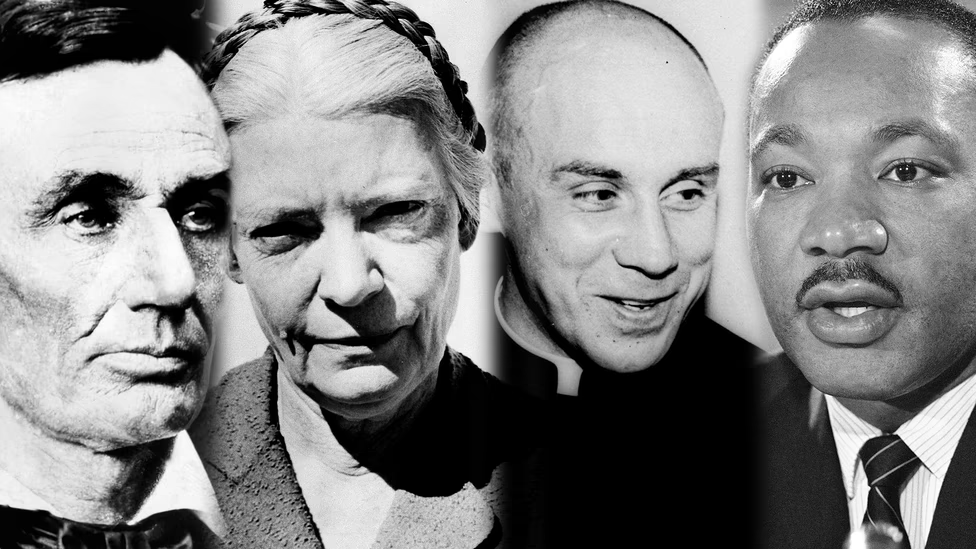
Now, of course, we look to her as a saint: her way of seeing and acting in the world a model for holiness. In his historic address before the U.S. Congress in 2015, Pope Francis reflected that a nation is considered “great” when it “strives for justice and the cause of the oppressed” and cited Dorothy as an example of a great American, a source of hope and encouragement. To the Guild’s immensely joyful surprise, he placed her, the sole woman, along three other Americans: the monk, Thomas Merton; the apostle of non-violence, Martin Luther King; and lo and behold: Abraham Lincoln!
I wasn’t embarrassed by the tears rolling down my cheeks. I even made a “firm resolve” — words from the Act of Contrition straight out of that old
Baltimore Catechism, recited after making a thorough “examination of conscience” — to shoulder some weight-bearing loads, however truly modest, of my own.
Share this post