Advent Greetings
Dear friends,
Advent greetings to each of you! We hope that in the midst of what for many of us is a busy, exciting, and sometimes stressful time of year, you have had a few moments of peace where you have been reminded of the joy we are all anticipating. Christ is again coming into our midst, in order to make us members of His Body and draw us closer to each other and closer to God in love.

All of the prophets, both in Scripture and in our own time, point us towards this truth: following her conversion, Dorothy’s entire life was a response to the reality of the Incarnation and the presence of God in each person she encountered, especially the poor. Dorothy lived as if the Good News of the Gospel were really true! In this edition of the Dorothy Day Guild’s missive, we likewise have a lot of joyful news to share with you, as well as some incredible resources and reflections we hope will help you prepare to celebrate Christ’s birth into our world and into our hearts next week.
News from Rome!
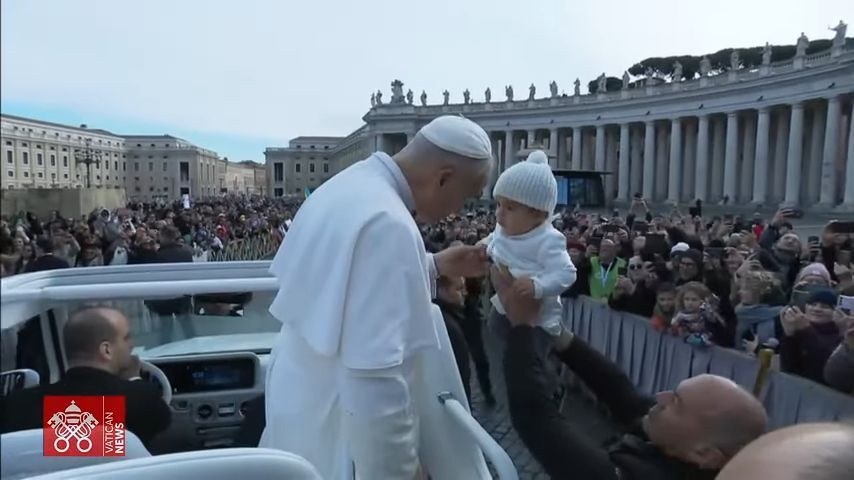
When Pope Leo’s first apostolic exhortation, Dilexi Te, came out earlier this fall, many of us eagerly read through it to see if the Holy Father would mention Dorothy in this text on love for the poor. Dorothy’s name never explicitly came up in the exhortation, but Pope Leo’s remarks, particularly in the section on popular movements, strongly reflected Dorothy’s unique mode of discipleship in the modern world. We suspected that given his emerging pastoral priorities and his American background, the Holy Father was likely aware of Dorothy and the Catholic Worker movement she founded, but we were floored when the Pope named her in his Jubilee Audience for pilgrims on Saturday, November 22nd!
“Jesus came to bring fire: the fire of God's love on earth and the fire of desire in our hearts. In a certain way, Jesus takes away our peace, if we think of peace as an inert calm. This, however, is not true peace,” Pope Leo said to the assembled pilgrims in St. Peter’s Square. Instead, “the peace Jesus brings is like a fire and asks much of us. Above all, it asks us to take a stand.” Speaking in Spanish, the Pope then invited the audience,
“to remember a small, great American woman, Dorothy Day, who lived in the last century. She had fire inside her. Dorothy Day took a stand. She saw that her country's development model didn't create equal opportunities for everyone; she understood that for too many, the dream was a nightmare; that as a Christian, she had to engage with workers, migrants, and those rejected by a killing economy. She wrote and served: it's important to unite mind, heart, and hands. This is taking a stand. She wrote as a journalist; that is, she thought and made others think. Writing is important. And so is reading, today more than ever. And then Dorothy served meals, gave clothes, dressed and ate like those she served: she united mind, heart, and hands. In this way, hoping is taking a stand.
Dorothy Day has involved thousands of people. They have opened homes in many cities, in many neighborhoods: not large service centers, but centers of charity and justice where they can call each other by name, get to know each other one by one, and transform indignation into communion and action. This is what peacemakers are like: they take a stand and bear the consequences, but they move forward.”
What an incredible gift, and an amazing surprise! English-language Catholic news sources including Aleteia and OSV News provided early summaries of the Pope’s remarks, and the entire audience is available to watch on YouTube with an English-language voiceover; Pope Leo’s address to the pilgrims begins at minute marker 26:28. This is the ninth catechesis in a series of Jubilee Audiences on hope, begun by Pope Francis in January of this year, and continued by his predecessor after his death this spring. You can read the full text of the Holy Father’s remarks on the Vatican website.
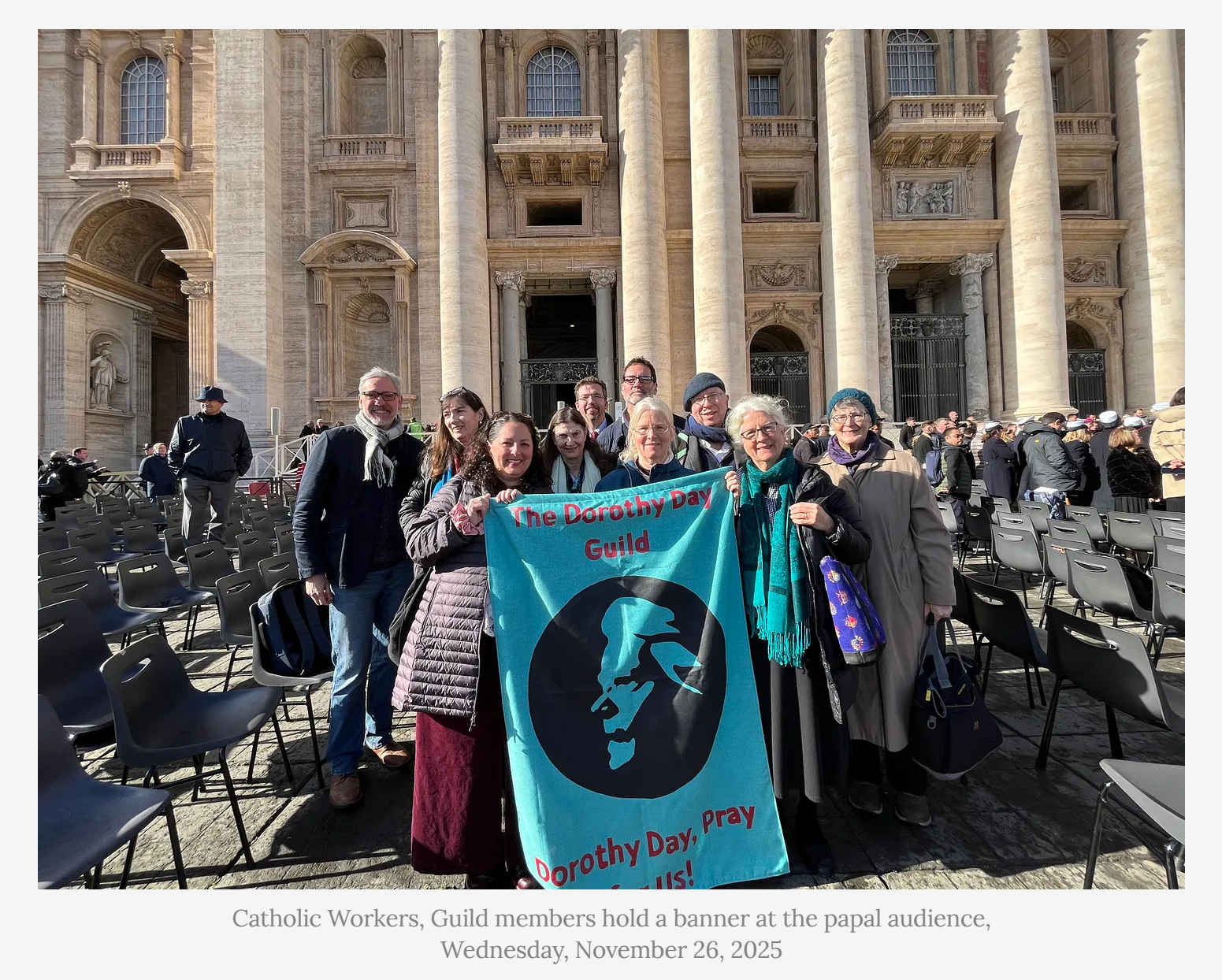
Pope Leo’s catechesis on Dorothy as an exemplar for the close of this Jubilee Year of Hope felt like a real grace as a small delegation of Dorothy Day Guild members and Catholic Workers began a pilgrimage to Rome the following Monday. This “pilgrimage of hope” took place in the days surrounding the academic symposium on Dorothy at the Pontifical Gregorian University– our first ever in-person international event! You can check out some of the pilgrimage highlights, including a papal audience in St. Peter’s Square, a meeting with our postulator, Dr. Waldery Hilgeman, at the Dicastery for Causes of the Saints, a visit to Santa Maria Maggiore to pray at the tomb of Pope Francis, and the closing mass in the crypt of St. Peter’s Basilica in this series of short videos on our Youtube channel. Enormous thanks to Thomas Gould, one of our pilgrims, for creating these mementos of the pilgrimage!
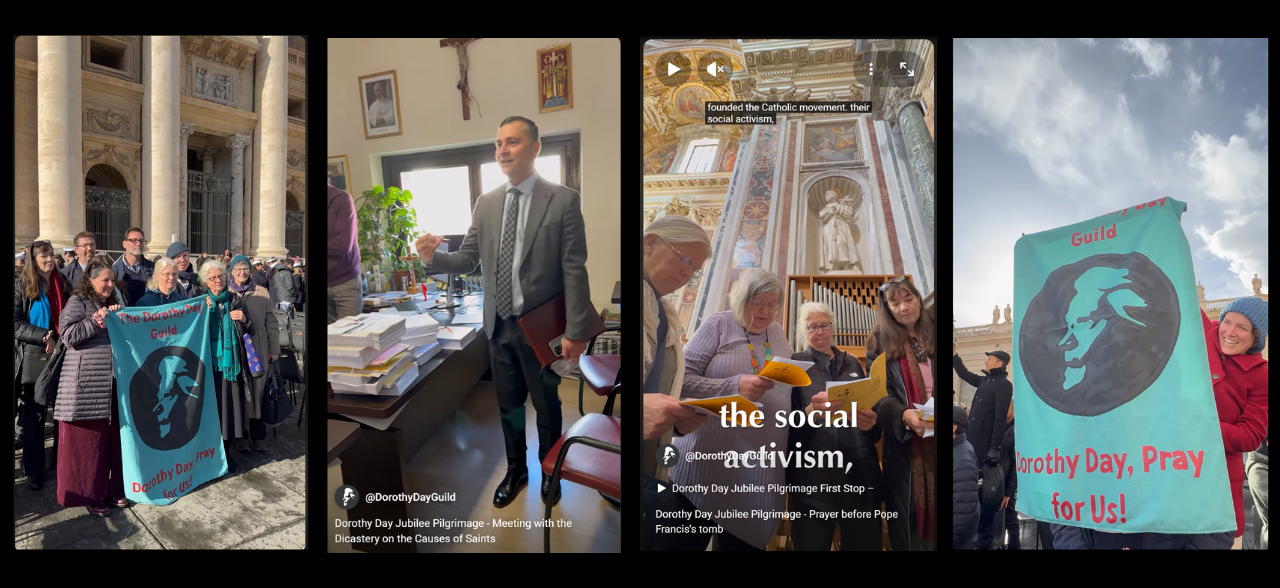
On Wednesday, November 26th, our pilgrims assembled at the Gregorian with approximately one hundred graduate students, professors, Vatican workers and officials, and members of the public to take part in a day-long academic symposium on Dorothy’s legacy. In addition to the in-person guests, dozens of additional participants tuned in virtually to the two main panels and the concluding remarks by Dorothy’s granddaughters, Kate and Martha Hennessy.
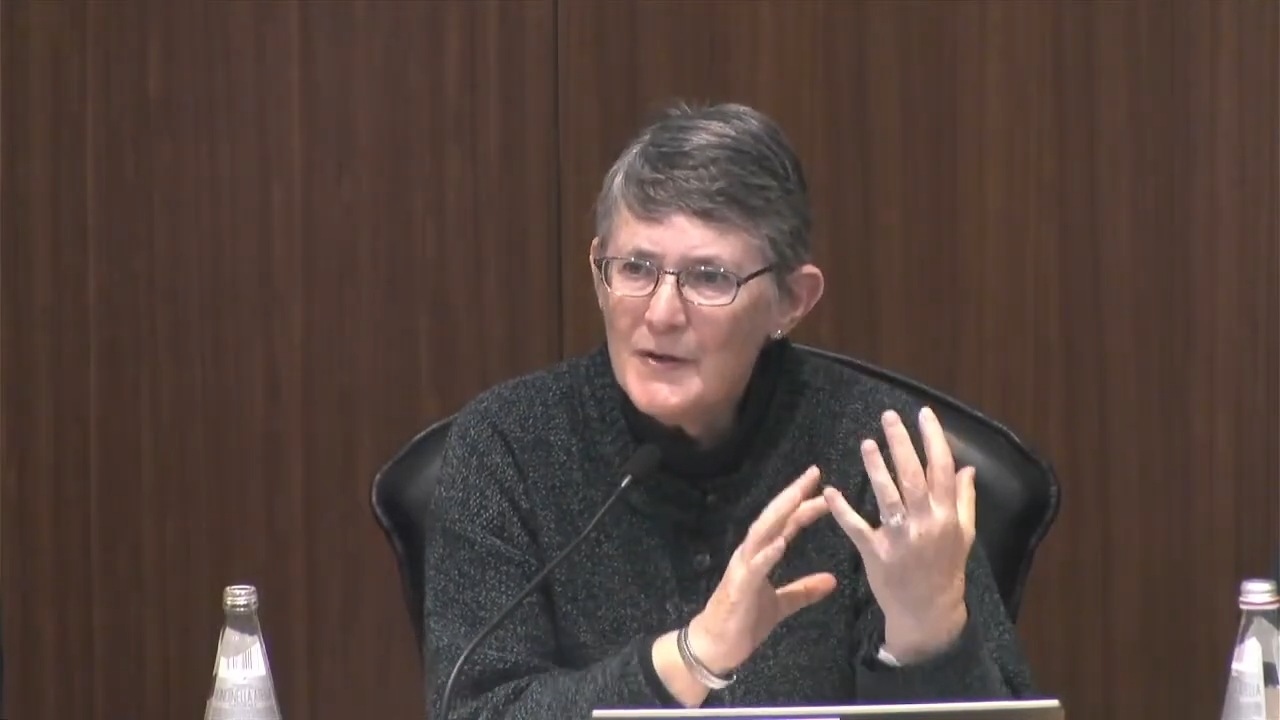
We’re delighted to share the full recordings of each of these talks with you, and we encourage you to watch or listen to them, perhaps as an Advent reflection in these last days before the Christmas celebration. Robert Ellsberg and Dr. Margaret Pfeil, professor of theology at the University of Notre Dame and member of the St. Peter Claver Catholic Worker community in South Bend each offered their comments for the opening panel, “The Spirituality of Dorothy Day: Significance, Originality, and Limitations.” Looking to Dorothy’s preconversion life for the first sources of what would ultimately bring her to God and become her distinctive expression of communion with the Divine, Margie remarked that,
“The wholeness, the integrity of God's love drew her to the sacramental life of the church as the hermeneutical key for her pilgrim journey. In her June 1956 Catholic Worker newspaper article entitled ‘Creation,’ she uses this lens of sacramental wholeness encompassing all of creation to set up what theologian Edward Schillebeeckx called a contrast experience, an awareness of beauty and joy contrasted against the background of devastation and suffering so acute as to sharpen their intensity.”
In this column, Dorothy compares the humility of the Incarnate Jesus with the hubris of American military scientists, who chose the feast of Pentecost to test a new hydrogen bomb over the Enewetake and Bikini atolls in the Pacific. She wrote,
"Americans are reaching for the moon now and our planes climb to unbelievable heights. And it is not just a desire to seek the womb to return to the earth when we say that it is necessary as never before man for all people to kiss the earth from which we spring and which has been so ennobled by Christ who took on our humanity. Man must become humble and know that it is God who created him and all the beauty around him. In the midst of this beauty, yesterday on Pentecost, the hydrogen bomb was dropped from the air over a Pacific island. The flash was equal to 500 suns and according to one reporter, it was like a nightmare in broad daylight… The contest between man and God. It was as though man were trying to shut off the earth from heaven, from God himself."
“Pentecost,” Margie went on to note,
“happened to be Dorothy's favorite feast, the day of her confirmation when she wrote about feeling indeed the Holy Spirit. That sacramental lens helped her name the existential danger at hand with eyes wide open. And it led her once again to praise God the creator. Kissing the earth, the humus became for her a sacramental reminder of human creatureliness. Called to cooperate with God the creator rather than worship idols of our own making. To surrender to the Holy Spirit's flame of love rather than glory in the hydrogen bomb's flash.”
The symposium’s second panel, “The Social Action of Dorothy Day: A Critical Evaluation,” opens with a brief message of welcome from Cardinal Timothy Dolan, expressing his good wishes for the symposium and his hopes for Dorothy’s eventual beatification and features talks from our Guild chair, Dr. Kevin Ahern, and Dr. Diego Alonso-Lasheras, SJ, a faculty member at the Gregorian.
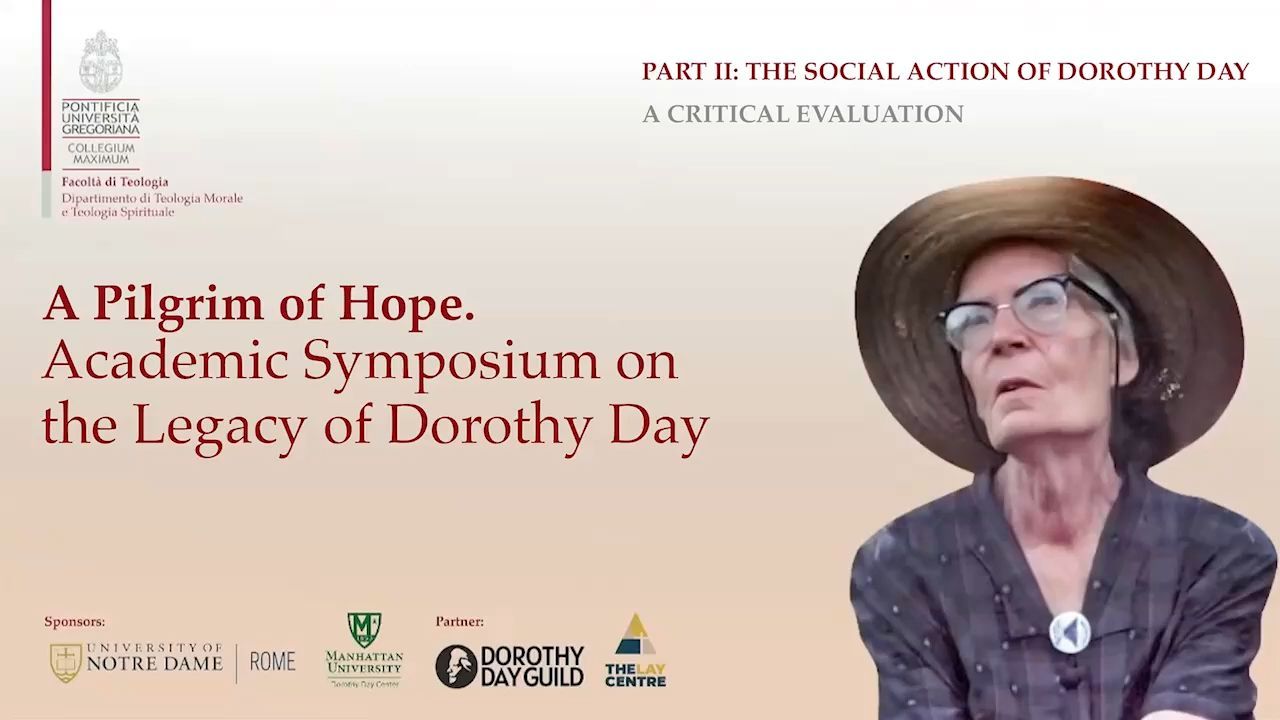
These presentations consider Dorothy as not simply a Catholic activist, but as a Church reformer and exemplar of Catholic social engagement in what theologian Kristin Heyer calls the “prophetic style,” working “outside traditional structures to denounce injustice and challenge those in positions of power through direct action and moral witness.” This legacy, Kevin notes, is alive and active today in the work of Catholic peace organizations like Pax Christi and the efforts for nuclear disarmament in the Plowshares and Catholic Worker movements.
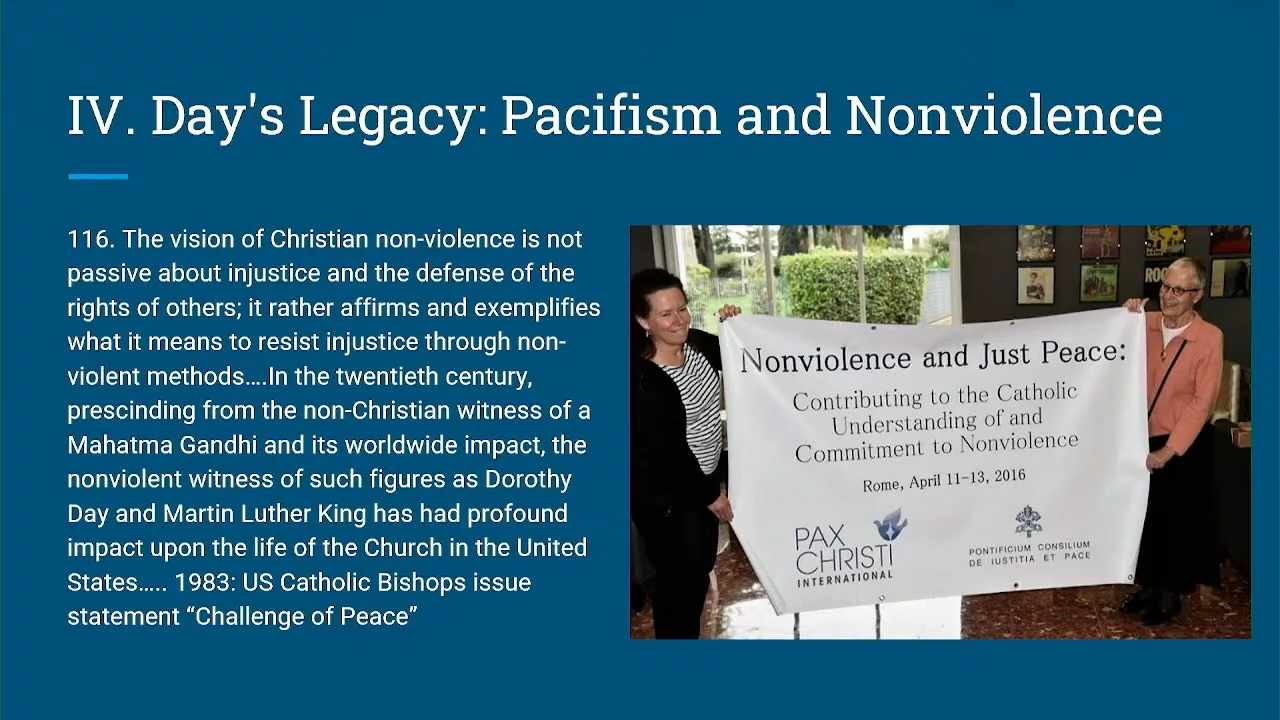
The events of the symposium concluded with a joint closing address from Martha and Kate Hennessy, entitled “The Legacy of Our Grandmother.” Kate and Martha’s comments are intimate, personal, and reflective; the formation Dorothy offered each of them and the relationships they shared are not relics of their childhood and early adult years, but a living flame and continuing challenge.
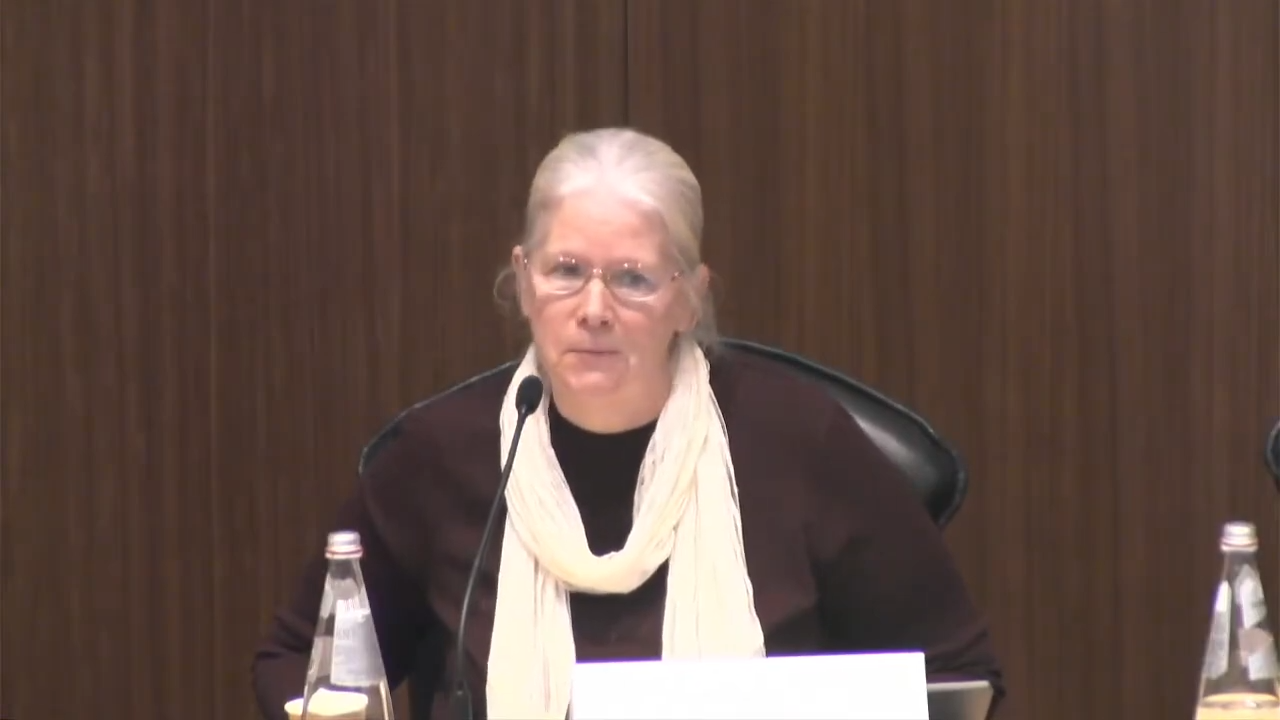
“People often comment to me on how taken they are by Dorothy's love for the poor. I have never felt that this is an accurate representation of her life and work,” Kate said.
“The Catholic worker wasn't the poor. It was her family. It was her community. and its creation came from a deep recognition and response to the human condition and how we are all in need in one way or another. She said there is always some way we can be generous with one another and to truly perceive one another in our humanness, our capacities, our sorrows and sufferings, not as observers or social workers but as community. Dorothy challenges us in many ways, Institutionally, economically, and politically. But most of all, she challenges us personally. She asks us to trust, to trust Christ when he says to love one another, our neighbors and our enemies, and to open our doors and our hearts to strangers in need.”
Fiona Murphy offered a brief summary of the symposium’s major themes, published in National Catholic Reporter on December 2nd. For a full recap of the Dorothy Day Guild’s first pilgrimage of hope, check out Renée Roden’s article, “‘This is her time,’ Catholic Workers Bring Dorothy Day’s Radical Witness to Rome,” which includes some great photos from our delegation and notes from Thursday’s roundtable discussion at the Lay Centre and Kevin Ahern’s Friday presentation at the Pontifical Lateran University. This was truly a banner week for our cause, and we couldn’t be more excited to see what the new year brings, both in terms of Dorothy’s formal canonization process, and all the ways in which her legacy of Gospel nonviolence, voluntary poverty, and hospitality is lived out in our Church and our world today.
Local Interest:
Closer to home (for those in and around New York City, anyway!), we’d also like to pass along two brief news items. Many Catholic Worker communities and their supporters, including the Staten Island Catholic Worker, celebrated special masses, vigils, and prayer services to mark Dorothy’s anniversaries of birth and death last month. It’s been a joy to witness the return of the Catholic Worker movement to Dorothy’s beloved Staten Island, and we were excited to learn that the community “has also been in contact with Councilman Frank Morano to discuss several potential proposals to honor Day’s legacy, including a street sign, a commemorative marker and a community garden.” Projects like these are important for our canonization cause, as they indicate widespread devotion to and interest in Dorothy and her legacy among the faithful; we look forward to hearing more about these plans as they progress!
At Maryhouse and St. Joe’s on the Lower East Side, we’ve also received notices from neighbors, concerned parishioners, and members of the Greenwich Village Society for Historic Preservation about the campaign to preserve Most Holy Redeemer Church, located at 173 East 3rd Street and grant the building landmark status in recognition of its significance for the architectural and cultural heritage of the neighborhood.
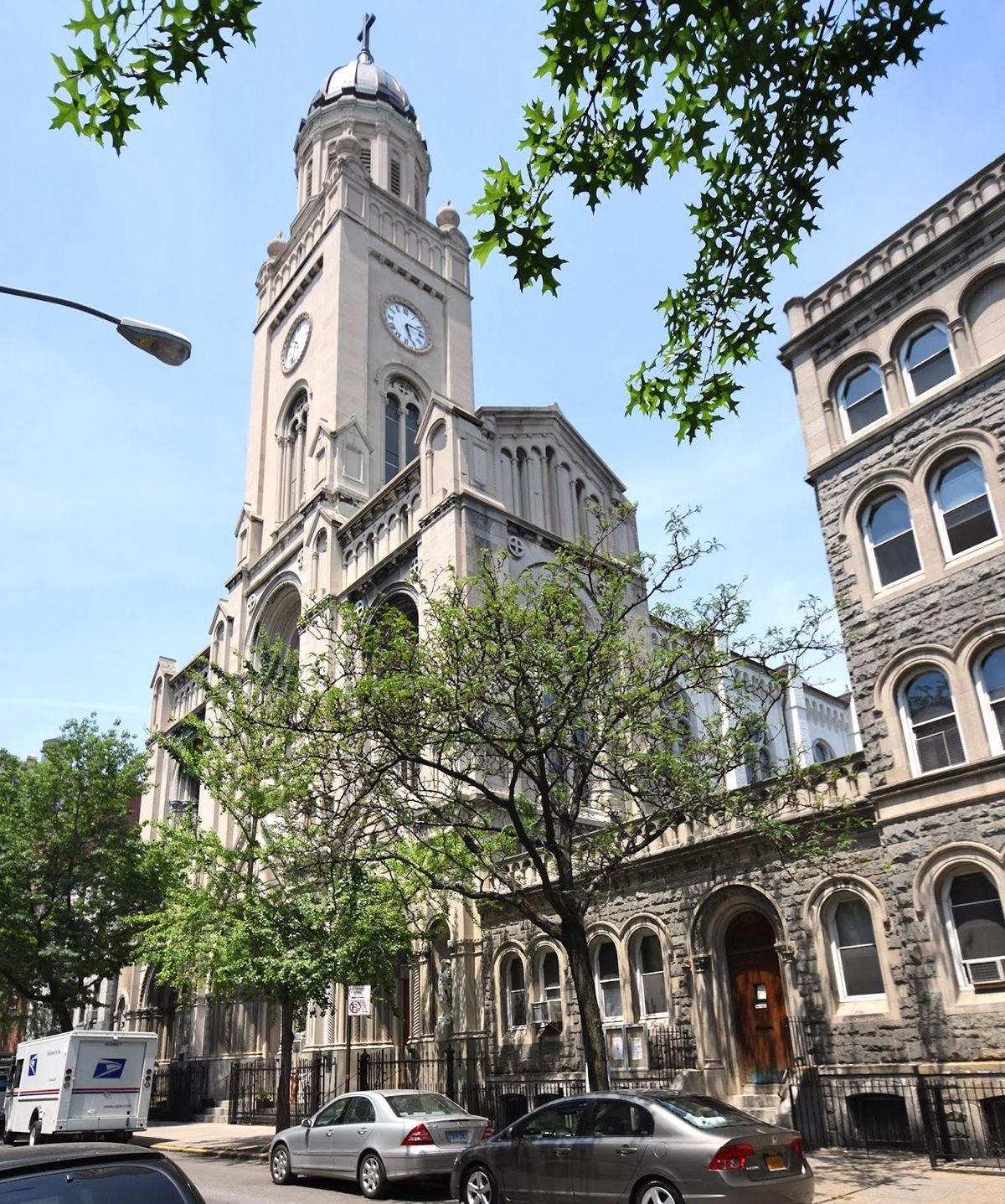
Most Holy Redeemer is a historically German parish, founded in 1844 by Redemptorist missionaries to serve the growing immigrant community. Dorothy occasionally attended services or stopped into this church to pray, writing in March of 1952,
“We walked a few blocks north to Third street between Avenue A and B and visited the Church of the Holy Redeemer, where the altar was gorgeous with cala lilies and roses, surrounding the exposition of the Blessed Sacrament. There are many Slavs in this neighborhood, but Germans predominate, and the streets are quiet and clean and orderly compared with the hectic clamor of the market district a few blocks below.”
The church still displays a small memorial to Dorothy near the entrance. Although Redeemer was never Dorothy’s primary parish, following the demolition of the Church of the Nativity, it is the only remaining Catholic Church in her neighborhood that can boast this connection. If you would like to send an email to the mayor’s office requesting that Redeemer be preserved as a historic landmark and receive updates on this campaign, please click here.
Dorothy at National Catholic Worker Gathering 2025:
We have several excellent talks and articles to share with you this month, covering a wide range of topics and perspectives. First, our thanks go out to Renée Roden, Jerry Windley-Daoust, and Brianna DellaValle for making the video recordings and transcripts of several presentations from the October National Catholic Worker Gathering in San Antonio, Texas, available online at CatholicWorker.org. On Friday, October 3rd, Robert Ellsberg and Fr. Ron Rolheiser each offered keynote addresses focused on Dorothy’s legacy and ongoing significance. Robert’s talk, “What I Learned from Dorothy Day” is a reflection on his years first working alongside Dorothy at the Catholic Worker in New York and then, following her death, working with her columns, diaries, and letters as her editor. Robert remembers one of the first things he realized about Dorothy when he first met her fifty years ago:
“She was not a sentimental person. She knew that poverty and suffering are hard. She knew the sights and smells of destitution, the craziness, the life of the insulted and injured, as she said. People used to praise her for her, quote, ‘wonderful work among the poor.’ She knew that a lot of it wasn’t really all so wonderful. It was also discouraging. It was exhausting. It was unrelenting.
And yet, I also learned from Dorothy that you have to learn to see beneath the surface of things. On the surface, you can see what seems like noise, chaos, ugliness, squalor. Dorothy had an eye for the transcendent, a capacity always to see something deeper—a deeper truth, a deeper goodness. It was there if you knew where to look for it…
I learned from Dorothy that to live that way can be a tremendous adventure. When you were with Dorothy, you didn’t have a feeling of gloom or hopelessness at all, despite all the difficulties and frustrations. There was so much joy and celebration.”
Fr. Ron Rolheiser, the former president of San Antonio’s Oblate School of Theology, gave the second keynote, “Dorothy Day as a Template of Christian Prophecy.” Fr. Rolheiser’s talk is organized around nine principles he identifies as paradigmatic for Christian prophecy, including a commitment to nonviolence, a foundation in love rather than ideology, a preferential option for the poor, hope, patience, and discernment. Dorothy embodied each of these. “Prophets don’t predict the future; they name the present—especially in light of God’s love for the poor,” Fr. Rolheiser reminded those gathered. He continued,
“In the Old Testament the prophets insisted that the quality of your faith is judged by the quality of justice in the land—and justice is judged by how the most vulnerable fare: widows, orphans, and strangers.
Today we might say: immigrants, the incarcerated, the unhoused, the excluded…
Dorothy Day lived with and for the poor. Breadlines and hospices weren’t enough—she pushed for communities of work, solidarity, and justice.”
If you weren’t able to attend the gathering back in the fall, we encourage you to check out both these excellent talks!
The following day included a full slate of roundtable discussions, two of which we’d like to highlight for you here. First, Brian Terrell offered a presentation on protest and incarceration, “Fill the Jails! A Catholic Worker Vocation,” which he began by quoting Dorothy’s February 1957 column on her own experiences of being jailed following that year’s civil defense drill protests:
“When I think of the long sentences served by so many others, of so many miscarriages of justice; when I think of the accumulation of prisons, outmoded and feudal, that dot the land… I’m not particularly interested in writing about my few days in jail last month. I’m just glad that I served them, and I’m ready to serve them again if there is another compulsory air-raid drill next summer. It’s a gesture, perhaps, but a necessary one. Silence means consent. We cannot consent to the militarization of our country without protest.”
Brian continued with a reflection on the works of mercy, and incarceration as a formative experience that blurs (though does not entirely erase) the boundaries of class, privilege, and status between the poor and those who seek to serve them. “Dorothy wrote not only about the number of people in prison, but about how American prisons have become so much worse. Visiting the prisoner is harder now; many prisons only allow video visits,” he said.
“Sometimes you must bring your family to a jail lobby to sit in front of a screen to see your loved one. Mail has also changed. Some jails allow only prepaid postcards. Martha was once in a jail where that was the only mail you could send. Imagine what we would lose: no Letters of Paul, no Dostoevsky, no Solzhenitsyn—only what fits on a 3×5 card. More than ever, the way to “visit the prisoner” is to be one.
Dorothy often quoted Dostoevsky: “The degree of civilization in a society is revealed by entering its prisons.” It’s true: you understand the whole country better after that experience.”
Our thanks to Brian for leading this discussion of one of the most challenging aspects of Dorothy’s legacy and reminding us of the reality experienced by so many people, especially the poor of the United States, who are unable to escape the impact of our system of mass incarceration on their families and neighborhoods.
Finally, Scott Schaeffer-Duffy and Martha Hennessy together led a roundtable discussion on ordinary practices of nonviolence for daily life, published as “Living Nonviolence Every Day: Stories and Insights.”
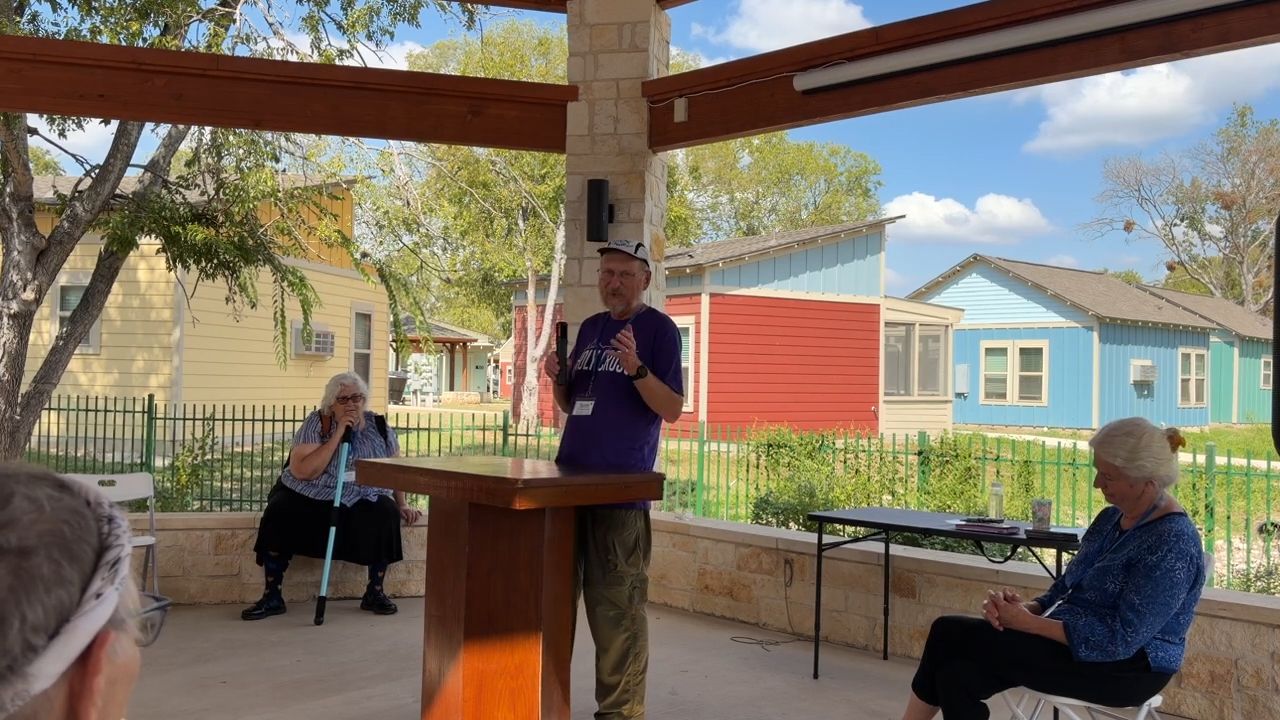
Scott opened the discussion with a brief explanation of where opportunities to practice Gospel nonviolence are hidden in our day-to-day encounters with others:
“I want to touch on two examples of nonviolence that are different than protests and taking a political position. Because some of us will decide to do that—put ourselves on the line, risk arrest, and whatever—and that’s a kind of nonviolence. But all of us in our life have situations where people threaten us. They get angry. People might even threaten us legally. What do we do?”
Scott then offered two anecdotes where Dorothy’s example inspired him to respond to potentially violent or volatile situations with creative and disarming nonviolence. On one occasion, he found himself,
“walking at night near the house down on New York Avenue. A guy comes up to me, pulls out a knife, and says, “Give me your money.”
I reached in my front pocket, pulled out a five-dollar bill, and gave it to him. I thought about Dorothy Day, and I said, “Can I ask you a question?”
He said, “What?”
I said, “What do you need it for?”
He said, “If it means anything to you, it’s for food for my kids. I lost my job. It’s for my kids.”
I said, “Wait a minute.” I reached into my back pocket where I had a twenty-dollar bill and said, “Here, take this. Go to the Catholic Worker House. It’s over here. This is the address. We get food all the time. Come on over tomorrow. We’ll hook you up. We’ll take care of you.”
He goes, “Oh, wow. I can’t take your money.”
I said, “Here, look at this. Put the knife away”...
He ended up being a volunteer and really helping us. And I thought, you know, this is a good idea.”
In a culture that is so primed to equate violence with strength and to see the ability to strike first as a demonstration of righteousness, Scott and Martha here offer us wise reflections on a Little Way of Nonviolence. We encourage you to check out these talks and the others that are archived on the Catholic Worker website’s page for the 2025 National Gathering. This was a wonderful celebration, and we’d like to express our gratitude to the San Antonio Catholic Worker for organizing and hosting this weekend and congratulate them on their community’s fortieth anniversary!
Additional Reading and Viewing Recommendations:
This season always brings so many excellent new pieces inspired by Dorothy’s life and witness to the Gospel; in addition to the wealth of longer presentations and talks we’ve curated this month, we’re also excited to share a few stand-alone pieces. Last month, Renée Roden spoke at a meeting of Francesco Collaborative, giving a short talk called “Why Catholics Embrace Voluntary Poverty.” Here, Renée says,
“Poverty is a mystery that Dorothy Day describes as one we must constantly write about and encounter. For if we are not among its victims, she says, its reality fades from us. We must talk about poverty because instead we'll become people insulated by our own comfort and lose sight of it. Voluntary poverty is a path you walk. It's never over. It's never complete. You've never given away enough. We’re never poor enough except for the one God-man who emptied himself deeming equality with God not something to be grasped and who took on the form of a slave within that sacrifice of Christ, the ultimate voluntary poverty. All of our efforts are sanctified and completed but here in this practice of Christian life on earth all of us are constantly battling with what Dorothy Day called ‘the octopus of our grasping self.’”
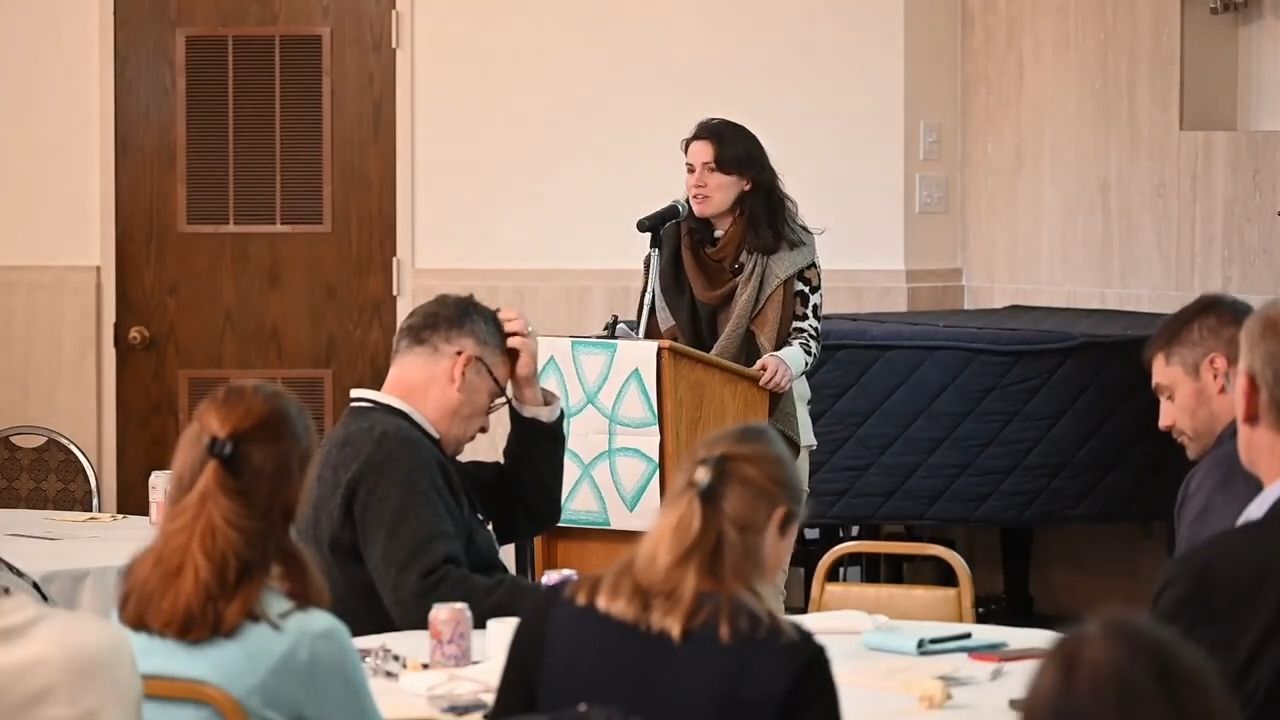
Later, Renée offers a few suggestions on how we might incorporate the practice of voluntary poverty into our own lives– perhaps you might be inspired to choose one of these examples as a spiritual discipline for the final week of Advent!
For Commonweal, Colin Miller recently published “Dying to Work: Byung-Chul Han and the legacy of the Catholic Worker.” This piece is a solid introduction to the work of Han, a Korean Catholic philosopher who engages issues of efficiency and alienation in contemporary economic and technological culture. Colin sees Han’s work as a lens through which we can realize the increasing significance of Dorothy and Peter Maurin’s often-baffling practices of pacifism and voluntary poverty in economic conditions which have only become more totalizing and demanding in the forty-five years since her death. Han
“helps us see the way that Catholic Worker theory and practice are related. The most radical critiques of our social order, he shows, come from those who refuse to submit to the demand that we spend our lives trying to get out of life alive. In this way, Day’s and Maurin’s prodigal lives made them walking rejections of the order of totalized work.”
Dorothy “lived in close proximity to bodily harm, fights and weapons being commonplace at St. Joseph’s House. And yet, consistent with her pacifism, she placed a strict ban on calling the police,” Colin reminds us.
“Such laid-back prodigality is a ‘festive’ or ‘playful’ way of life—in stark contrast to the anxious capital accumulation and obsession with health and safety so typical of our age. Han pinpoints exactly what made Day’s life so radical: she refused to try to work her way free of death.”
As we approach the Christmas season, these reminders of how Dorothy teaches us to respond to God’s extravagant generosity in the gift of the Incarnation are especially timely. The ‘holiday season’ in much of the Western world is a time when the dominant culture ramps up its economic demands to produce and consume more and more; Dorothy’s example reminds us that life itself is God’s gift and that our best response is simply gratitude and our own analogous, prodigal open-handedness.
Paulist media outlet Busted Halo also published a brief introduction to Dorothy as an activist and journalist whose work for justice was the expression of a prophetic vocation grounded in a Catholic understanding of the world and our place within it. Responding to his college-aged son’s anger and despair over ICE raids in the neighborhood where they once lived, author Michael O’Connell asked,
“How does one respond in the face of injustice? There are, of course, no easy solutions for wanton cruelty or rising authoritarianism, or for the targeting of the marginalized and weak. One place I’ve been turning for both inspiration and consolation is to the work of Dorothy Day, and I suggested that my son check out some of her old columns from ”The Catholic Worker,” where she wrote eloquently and powerfully about the Gospel imperative to resist injustice, and to embrace both the Spiritual and Corporal Works of Mercy as an antidote to the works of war.”
Last week, in an interview for Plough entitled “We Are the Alternative to War,” editor Charles Moore spoke with theologian Stanley Hauerwas on nonviolence as a Christological position, an expression of commitment to the doctrine of the Mystical Body of Christ rather than another ideology or foreign policy proposal. In the interview, Moore asks,
“Christians have a higher allegiance [to Christ] than to nation states. And yet it seems like nation states do what nation states do. How do we live faithfully in the midst of such a world where nation states and what they do or fail to do have such dramatic and horrendous effects?”
Hauerwas responds,
“We produce people like Dorothy Day. That’s how you go about providing an alternative to the nation state. In the book that I’ve written, War and the American Difference, I tried to show how the war-making character of the modern nation state is a sacrificial system that commands a loyalty that is, from a Christian perspective, idolatrous. And that is something that the church has to say in America in particular.”
It is deeply encouraging to see Christian publications and writers from a variety of denominations and traditions engaging with the implications of Dorothy’s nonviolent praxis for the conflicts we face here in the United States as well as in the global political sphere as we look forward to the coming of the Prince of Peace!
Finally, we came across a profile of College of the Holy Cross director of liturgy and music Laurence Rosania, “The Lessons of a Life in Music,” published in the most recent edition of Holy Cross Magazine. Rosania, who grew up in a working-class Catholic family in Philadelphia, attended the 1976 International Eucharistic Congress, where he heard both Dorothy and Mother Teresa speak. Both women made a strong impression on the young college student.
“I remember Mother Teresa brushing past me as she was walking, and I thought, I am in the presence of something extraordinary,” he recalled. “I don’t know what it was — saintliness, holiness. With Dorothy Day, it was a completely different impression. With her, it was a feeling of tremendous strength, like you were in the presence of a great mountain or something.”
Rosania went on to join the New York Catholic Worker community in 1979, helping on the soup line at St. Joe’s and coming to know Dorothy in the last year of her life. Already a skilled musician who had been performing professionally from the age of nine onward, Rosania began taking small gigs playing organ and piano at local churches to supplement his modest volunteer stipend of five dollars per week from the Catholic Worker house. When Dorothy died in 1980, Rosania played the organ at the Church of the Nativity for her funeral mass.
“The organ I played on barely made a sound, and the church was kind of falling down, and Dorothy was in the simplest little pine box,” he remembered, “but everybody was there, from the cardinal to the papal nuncio.”
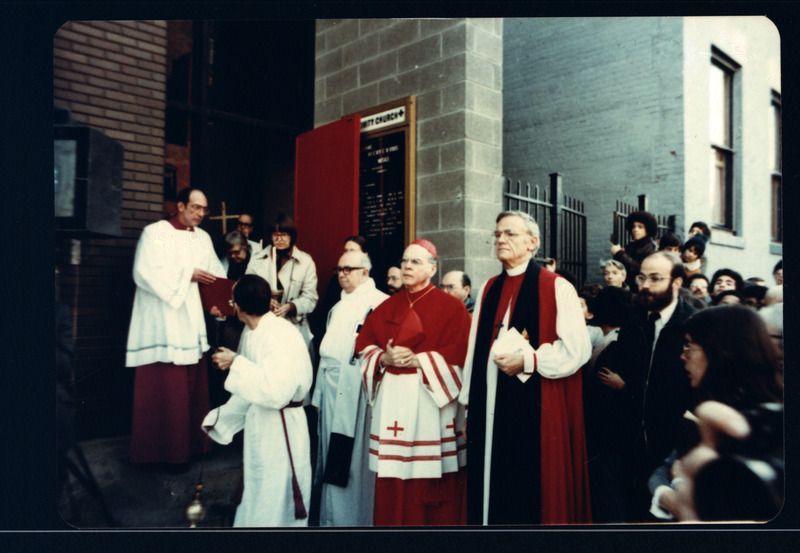
This profile is a beautiful testament to the impact Dorothy had on one of the countless young people who spent time at the Catholic Worker over the decades. Dorothy never felt that it was imperative that every young person who came to volunteer remained at the Worker for the rest of their lives, as she had. Rather, she had a gift for encouraging each person she met to discern and live out their own vocation, helping Rosania and many others like him to use their God-given talents in the service of the common good. Many thanks to Holy Cross Magazine for this unique window into Rosania’s encounter with Dorothy and the good fruit it has borne.
Prayer Requests:
Recently, we mentioned a parish in Vermont where a group was meeting on Tuesday nights in order to discern the possibility of opening a Catholic Worker house in the Williston area. Led by Deacon Josh McDonald, the group began with a series of talks on Catholic social teaching and has now published seven editions of a newsletter. You can read more about their initiative in this profile from Roundtable. As Deacon Josh and his fellow discerners continue meeting, assessing local needs, writing, and discussing fundraising, please keep this new community in your prayers!
We also received a request last month from a woman in Massachusetts whose friend is suffering from Stage 4 cancer. Please join us in praying through Dorothy’s intercession that T. makes a full recovery, and that God would guide the hands of her medical team and offer consolation and sustenance to T. and her loved ones in this difficult time.
Finally, Phillip wrote to us from Saskatchewan with an incredible story and a request for intercession. He recently invited a formerly homeless woman, K., to come and live with him, and together, they have transformed his modest home into a true house of hospitality, welcoming others from the street to share meals with them, shower, and enjoy a few hours of respite from the elements. Phillip has asked for prayer on behalf of K., that she might be healed of all the trauma she experienced earlier in life and that God will continue to bless their efforts to offer hospitality to unhoused their neighbors this winter. Please join us in praying for this good work of the Gospel.
A few words from Dorothy:
In November and December of 1966, Dorothy wrote a four-part series for Ave Maria magazine, entitled “Reflections During Advent.” She chose a different theme each week, beginning with her own spiritual journey and continuing with a reflection on one of the counsels of perfection, poverty, chastity, and obedience each of the following weeks. In the first reflection, Dorothy says that from early childhood, she had been literally haunted by God, plagued by terrifying dreams of an awesome and awful Divine power. It was Dorothy’s mother, Grace, who would come to her in the night and comfort her when these nightmares frightened her awake, and later, a Catholic childhood friend named for the Blessed Mother told her about Mary as a warm and loving presence in heaven. When Dorothy finally came to faith in the Catholic Church, it was her own experience of motherhood that awakened in her a need to adore and to give thanks to the Creator and Parent of us all. She writes,
“God was our Father, so I could approach Him, daring to say, Our Father. But it was reading of Jesus Christ in the New Testament that made me want to put off the old mail and put on Christ, as St. Paul said. And who had given me our Lord but the Virgin Mary? It was easy to pray to her, repetitious though it might seem. Saying tire rosary as I did so often, I felt that I was praying with the people of God, who held on to the physical act of the rosary as to a lifeline, a very present help in time of trouble…
Every day at the Catholic Worker Farm when we gather for meals we say the Angelus before asking God’s blessing on us and the food we eat. And it rejoices me to hear all the men, who are in the majority, saying, ‘Behold the handmaid of the Lord, be it done unto me according to Thy Word,’ and repeating together that marvelous and yet terrible prayer,
‘Pour forth we beseech Thee, O Lord, Thy grace into our hearts, that we to whom the Incarnation of Christ was made known by the message of an angel, may by His passion and cross be brought to the glory of His resurrection.’ This Incarnation came about by Mary’s consent, she ‘through whom we have received the author of life.’
So Advent must begin with Mary, who presents us with the infant Christ. “The flesh of Jesus is the flesh of Mary,” St. Augustine wrote. “The Word was made flesh and dwelt among us.”
When I go to the crib this year I will think, as I always do, that we are not dependent on the governments of this world for our safety, but ‘the government will be upon His shoulder.’ This baby cradled in a manger, this boy talking to the doctors in the temple, this youth working with St. Joseph as carpenter, this teacher walking the roads of Palestine, ‘Do whatever He tells you,’ Mary told us.”
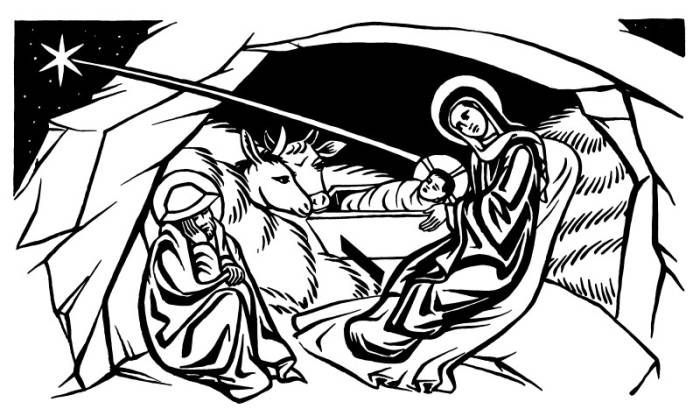
We’d like to leave you with this beautiful reflection on the Mother of God in these last days of Advent. As we wait with Mary for the birth of her Son, let’s pray along with the Blessed Mother that like Dorothy, we receive the strength and courage to follow Him and do what He asks of us with that same faith and trust. We pray that each of you takes comfort in the reality of the Incarnation this season and the peace Christ promises his people.
In peace,
Dr. Casey Mullaney, on behalf of the Dorothy Day Guild
Share this post